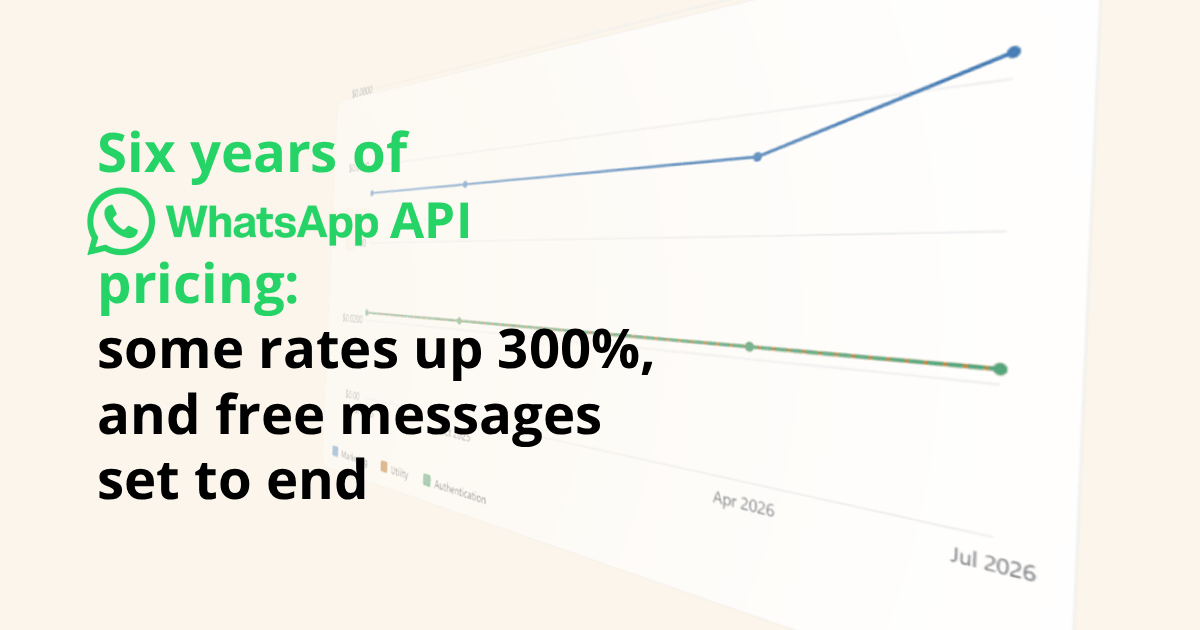
Meta only changes WhatsApp Business Platform rates on the first day of a calendar quarter, and it publishes the new card about a month before. The Q3 2026 card took effect on 1 July 2026, and it was a busy one: six markets left their regional buckets for standalone rates, utility and authentication prices rose across most of those markets, Poland was cut hard, three Western-European marketing rates crept up, and Brazil gained the option to be billed in its own currency. This is a plain-language roundup of every change, with the figures before and after.
Every number below is Meta’s platform fee per delivered template message, in US dollars, the unit the per-message model has billed in since 1 July 2025, and every one is answerable to our dated ledger, where the figures come with sources. To price your own market and monthly volume, use the WhatsApp API Pricing Calculator; to see the full history with provenance, see the pricing change history; to see the shape of a rate over time, see the price-trends chart.
The headline: six markets went standalone
Hong Kong, Hungary, Poland, Qatar, Romania and Singapore moved out of the regional groups they used to sit inside (the various “Rest of…” buckets) and onto their own market-specific rate cards. Two things change when a market goes standalone: its price is now set on its own rather than inheriting the region’s, and its volume tiers become market-specific, the discounts for utility and authentication no longer accrue against the pooled volume of the whole region but against that one market’s traffic.
That structural move is why five of the six saw their utility and authentication prices jump: a standalone rate was set higher than the regional one they were leaving. Poland is the exception, it went standalone and got cheaper across the board.
Rate moves, market by market
All figures are USD per delivered message, diffed against Meta’s rate card effective 1 July 2026. Since July 2025, utility and authentication carry the same list rate in almost every market, which is why the two move together here.
| Market | Category | Was (USD) | Now (USD) | Change |
|---|---|---|---|---|
| Hong Kong | Utility & authentication | 0.0113 | 0.026 | +130% |
| Hungary | Utility & authentication | 0.0212 | 0.035 | +65% |
| Singapore | Utility & authentication | 0.0113 | 0.016 | +42% |
| Romania | Utility & authentication | 0.0212 | 0.029 | +37% |
| Qatar | Utility & authentication | 0.0091 | 0.012 | +32% |
| Poland | Utility & authentication | 0.0212 | 0.0122 | −42% |
| Poland | Marketing | 0.086 | 0.0366 | −57% |
| United Kingdom | Marketing | 0.0529 | 0.0635 | +20% |
| Italy | Marketing | 0.0691 | 0.0795 | +15% |
| Spain | Marketing | 0.0615 | 0.0707 | +15% |
Poland is the quarter’s big winner. A marketing message to a Polish number fell from 8.6 to 3.66 US cents (a 57% cut) and its utility and authentication rates fell 42%. Poland is now one of the cheaper markets in Europe to reach on WhatsApp.
The newly-standalone Asian and Gulf markets mostly got more expensive on the transactional categories: Hong Kong’s utility and authentication rate more than doubled (+130%), and Hungary, Singapore, Romania and Qatar all rose between a third and two-thirds. If you send authentication (one-time passwords) or utility (order updates, alerts) into any of these, re-check your budget, this is the kind of change that doubles a line item without warning.
Western-European marketing crept up. The United Kingdom rose 20%, Italy and Spain 15% each. These are marketing-category moves only; utility and authentication in those markets were untouched this quarter.
Billing: Brazil can now be invoiced in reais
Alongside the rate moves, Meta added billing localization for Brazil: eligible customers can now create WhatsApp Business Accounts denominated in Brazilian reais, invoiced by Meta’s local entity, with existing accounts required to migrate by 30 June 2027. This is a billing-currency change, not a price cut, the underlying per-message rates are unchanged; you are simply invoiced in BRL instead of USD. It follows the same pattern as India’s rupee billing earlier in 2026.
Already announced for Q4 2026 (1 October)
Meta gives at least a month’s notice for a rate-card change, so the next quarter is already partly visible. Effective 1 October 2026, nine more markets go standalone: Bangladesh, Iraq, Nepal and Sri Lanka get lower utility and authentication rates, while Kazakhstan, Kuwait, Morocco, Oman and Ukraine get higher ones, and all nine gain an authentication-international rate above their current authentication price. The Q4 2026 update goes through that day’s changes, including the end of free service messages.
Separately, multiple providers report that service messages will become chargeable from the same date, ending the unlimited free service conversations that arrived in November 2024. We have flagged that one as reported, not yet confirmed against Meta’s own pricing page, see the pricing change history for the provenance on every entry, including which are official and which are second-hand.
How to use this
Remember that every figure here is Meta’s platform fee only. If you send through a Business Solution Provider (Twilio, 360dialog, Wati and others), that provider adds its own per-message or subscription fee on top. The pricing calculator estimates Meta’s side for any market, volume and category mix; the history and trends chart put this quarter in context. We refresh this roundup every quarter as the new card lands.