Most companies that message customers on WhatsApp learn that a price went up the same way: the invoice is simply higher than last month. Meta seldom announces a rate change, and the figures are quoted in fractions of a cent, so an increase that doubles the cost of a message can go unnoticed until the volume is large. We maintain a dated, sourced ledger of every WhatsApp Business Platform price change since 2019. Read end to end, it shows a pattern that no single quarter does. This is what six years of that record says.
One ground rule before the numbers: every figure here is Meta’s platform fee for one delivered template message, in US dollars, how the service has been billed since 1 July 2025, and each is backed by a source in our pricing change history, which also marks whether a figure comes from Meta or from a third party. To price your own market and volume, use the WhatsApp API pricing calculator.
The free tier that is about to end
In November 2024, Meta made service messages free and unlimited, the replies a business sends within 24 hours of a customer writing first. It was a real concession, replacing an older allowance of 1,000 free conversations a month, and many companies built their support around it.
That is reported to reverse. Several WhatsApp Business Solution Providers state in their own changelogs that service messages will be billed again from 1 October 2026. One caveat, stated plainly: Meta has not published this on its own pricing page, so we record it as reported, not yet confirmed and keep it apart from official figures. If the providers are right, a message type that has been free for almost two years returns to the bill, and any company relying on those free replies should be revisiting its numbers now, not in October.
Rates that rose without an announcement
Comparing Meta’s rate cards quarter by quarter, we found individual per-message prices that did not edge up but jumped. None was announced publicly; each surfaced only by placing one card next to the next.
| Market | Category | Was (USD) | Now (USD) | Change | When |
|---|---|---|---|---|---|
| Colombia | Utility & authentication | 0.0002 | 0.0008 | +300% | Oct 2025 |
| Hong Kong | Utility & authentication | 0.0113 | 0.026 | +130% | Jul 2026 |
| Pakistan | Utility & authentication | 0.0054 | 0.01 | +85% | Apr 2026 |
| Hungary | Utility & authentication | 0.0212 | 0.035 | +65% | Jul 2026 |
| United Arab Emirates | Marketing | 0.0384 | 0.0499 | +30% | Oct 2025 |
The percentages are accurate, and so is the qualification a careful reader will want: the base rates are very small, so Colombia’s 300% rise is a move from 0.02 to 0.08 of a US cent per message. That is negligible on a hundred messages and substantial on ten million, the scale at which authentication codes and utility alerts are actually sent. An unannounced increase that doubles a rate is the kind that reshapes a messaging budget without anyone approving it.
The increases are only half the picture
Reporting only the rises would be misleading. Over the same period Meta also cut several headline rates, some of them steeply. That prices move in both directions is what makes the increases credible rather than selective.
| Market | Category | Was (USD) | Now (USD) | Change | When |
|---|---|---|---|---|---|
| Turkey | Utility & authentication | 0.0053 | 0.0009 | −83% | Apr 2026 |
| Poland | Marketing | 0.086 | 0.0366 | −57% | Jul 2026 |
| France | Marketing | 0.1432 | 0.0859 | −40% | Jan 2026 |
| Egypt | Marketing | 0.1073 | 0.0644 | −40% | Jan 2026 |
| Mexico | Marketing | 0.0436 | 0.0305 | −30% | Oct 2025 |
The map is redrawn constantly. Any market can rise or fall on the first day of a quarter, and Meta gives as little as one month’s notice before a rate card changes. There is no single direction to WhatsApp pricing, only steady movement, and a reason to keep checking. The full before-and-after for the latest quarter is in what changed in Q3 2026.
The larger issue: four pricing models in six years
Beneath the individual rates is the point that matters most to anyone planning a budget: Meta has changed how it charges four times since 2019. Each change altered not only the price but the unit being billed, so comparing one year with the next rarely compares the same thing.
| From | Model | Billed unit |
|---|---|---|
| Jun 2019 | Per templated message, volume-tiered | Delivered template message |
| Feb 2022 | Conversation-based, two categories | 24-hour conversation |
| Jun 2023 | Conversation-based, four categories | 24-hour conversation |
| Jul 2025 | Per message | Delivered template message |
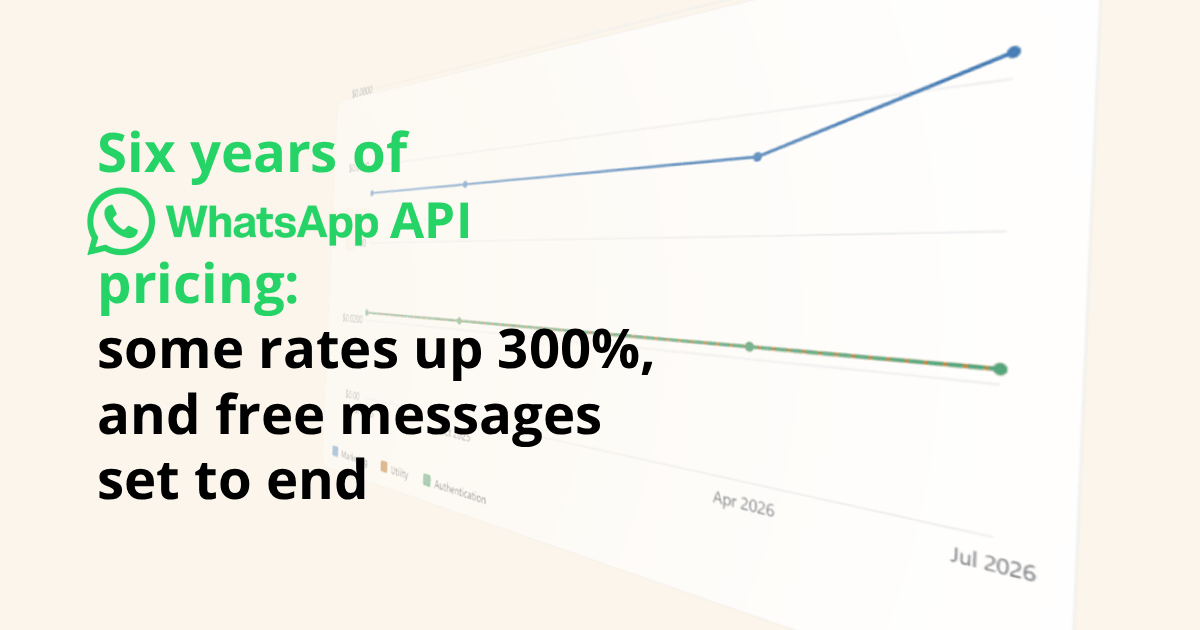
The billed unit has gone from a message, to a 24-hour “conversation,” and back to a message, while the categories beneath it were recut from none, to two, to four. A team that costed WhatsApp in 2023 was pricing a different product from one doing it today, before any rate moved. You can follow a single rate across the per-message era on the price-trends chart, or read the full model-by-model history in the pricing change history.
Why we track this
We build free WhatsApp tools, and pricing was the question we were asked most and could answer with the least confidence, because no one kept a sourced record of what changed and when. So we built one. Every figure in this article comes from that ledger: dated, and labelled by origin, from Meta, reported by a third party, or worked out by comparing two cards we hold. Where something is second-hand, such as the October 2026 service-message change, we say so rather than present it as settled.
The underlying data is published under a Creative Commons licence for reporters and businesses to cite and reuse; the machine-readable version is at wha.tools/api/data. The single takeaway: WhatsApp pricing is not a cost you set once. It is a moving figure that Meta adjusts each quarter, usually without comment, and the companies that stay ahead of it are the ones that check every quarter. We update this record as each new card is published.