Meta changes WhatsApp Business Platform rates only on the first day of a calendar quarter, and it publishes the new card about a month ahead. The card that takes effect on 1 October 2026 starts charging for two things that used to be free: service messages stop being unlimited and free, and utility replies inside the customer-service window are billed too. On top of that, nine markets move onto their own rates and several existing ones get more expensive.
Every rate below is Meta’s platform fee per delivered message, in US dollars, the unit the per-message model has used since 1 July 2025, read straight from Meta’s own October rate card. To price your own market and monthly volume, use the WhatsApp API Pricing Calculator; for the full record with sources, see the pricing change history; to see the shape of a rate over time, see the price-trends chart.
Service messages stop being free
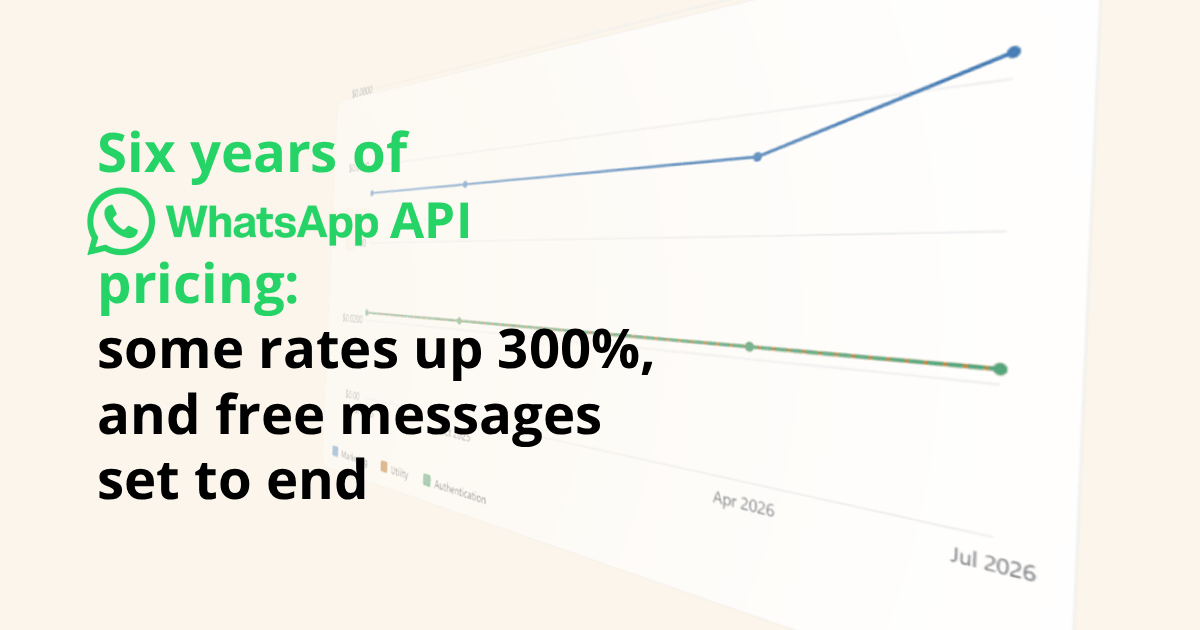
A service message is a free-form reply (not a template) that you send inside the 24-hour window a customer opened by messaging you. Since November 2024 those have cost nothing, with no cap. From 1 October 2026 they bill at the same rate as a utility message in that market. Every business phone number keeps the first 1,000 service messages each month free: you only pay from the 1,001st, the count resets on the 1st of the month, and any unused allowance does not roll over. For how the free window arrived in 2024 and where it sits in the wider price history, see six years of WhatsApp API pricing.
A second change rides along with it. Utility templates sent in reply inside that same 24-hour window (free since July 2025) are billed from 1 October too. So the open service window no longer makes anything free; it only decides when you are allowed to send a message at all. Marketing and authentication are unchanged in how they bill: marketing is always charged, authentication still earns volume discounts.
For most businesses the free 1,000 covers a normal month of support replies, so the day-to-day cost of this is small. Watch it if you run heavy support on a single number, the allowance is counted per phone number, so traffic split across several numbers gets several free tiers, and a single busy number is the one that reaches the 1,001st message. A service message costs that market’s utility rate, and our calculator now includes a service line that applies the free 1,000 for one number. For what a month of support costs now in ten markets, see how the current card works.
Nine markets went standalone
Bangladesh, Iraq, Nepal and Sri Lanka move onto their own rate cards with lower utility and authentication prices than the region they left; Kazakhstan, Kuwait, Morocco, Oman and Ukraine move onto their own cards with higher ones. All nine also gain an authentication-international rate, the separate, higher price for authentication messages sent to a number outside the market, set above the regional authentication price they were paying before.
Going standalone changes two things. A market’s price is now set on its own instead of inheriting the regional average, and its volume tiers become market-specific: the utility and authentication discounts no longer accrue against the pooled traffic of the whole region but against that one market’s volume.
| New standalone market | Marketing | Utility & authentication | Authentication-international |
|---|---|---|---|
| Bangladesh | 0.0732 | 0.0037 | 0.096 |
| Nepal | 0.0732 | 0.0034 | 0.112 |
| Sri Lanka | 0.0732 | 0.002 | 0.144 |
| Iraq | 0.0341 | 0.0079 | 0.128 |
| Morocco | 0.0414 | 0.023 | 0.0811 |
| Oman | 0.0341 | 0.0247 | 0.06 |
| Kazakhstan | 0.0604 | 0.018 | 0.16 |
| Kuwait | 0.0792 | 0.044 | 0.12 |
| Ukraine | 0.086 | 0.0298 | 0.0746 |
The South-Asian markets come out cheap on the transactional categories, Sri Lanka’s utility and authentication rate is 0.2 US cents a message, Nepal’s and Bangladesh’s under 0.4, which suits the one-time-passcode and alert traffic those markets send in volume. Kuwait sits at the other end at 4.4 cents. The authentication-international rate is the one to watch: at 9.6 to 16 cents it is many times the domestic figure, and it applies whenever the recipient’s number is registered outside the market.
The moves Meta didn’t spell out
Meta’s announcement named the nine standalone markets and prefaced them with "at least the markets Meta will move out", a hint that the list was not the whole story. Comparing its July and October cards directly turns up several more moves that the announcement never mentioned. All figures are USD per delivered message; since July 2025 utility and authentication carry the same list rate in almost every market, so the two move together here.
| Market | Category | Was (USD) | Now (USD) | Change |
|---|---|---|---|---|
| Mexico | Marketing | 0.0305 | 0.0397 | +30% |
| United Arab Emirates | Marketing | 0.0499 | 0.0576 | +15% |
| Saudi Arabia | Marketing | 0.0501 | 0.0576 | +15% |
| Rest of Asia Pacific | Marketing | 0.0732 | 0.0842 | +15% |
| Rest of Middle East | Marketing | 0.0341 | 0.0392 | +15% |
| Pakistan | Utility & authentication | 0.01 | 0.015 | +50% |
| Peru | Utility & authentication | 0.02 | 0.03 | +50% |
| South Africa | Utility & authentication | 0.0076 | 0.0095 | +25% |
Mexico’s marketing rate climbs 30%, which puts it almost exactly back where it was before Meta cut it a year ago, on 1 October 2025. The two regional marketing rates (Rest of Asia Pacific and Rest of Middle East) rose 15% each, and that is arithmetic as much as policy: when cheaper markets like Bangladesh and Iraq leave a regional bucket for their own rows, the average of what is left goes up. Pakistan, Peru and South Africa saw their transactional rates rise with no headline attached.
How to use this
Every figure here is Meta’s platform fee only. If you send through a Business Solution Provider (Twilio, 360dialog, Wati and others) that provider adds its own per-message or subscription fee on top. The pricing calculator estimates Meta’s side for any market, volume and category mix; the history and trends chart put this quarter in context. We refresh this roundup each quarter as the new card lands.