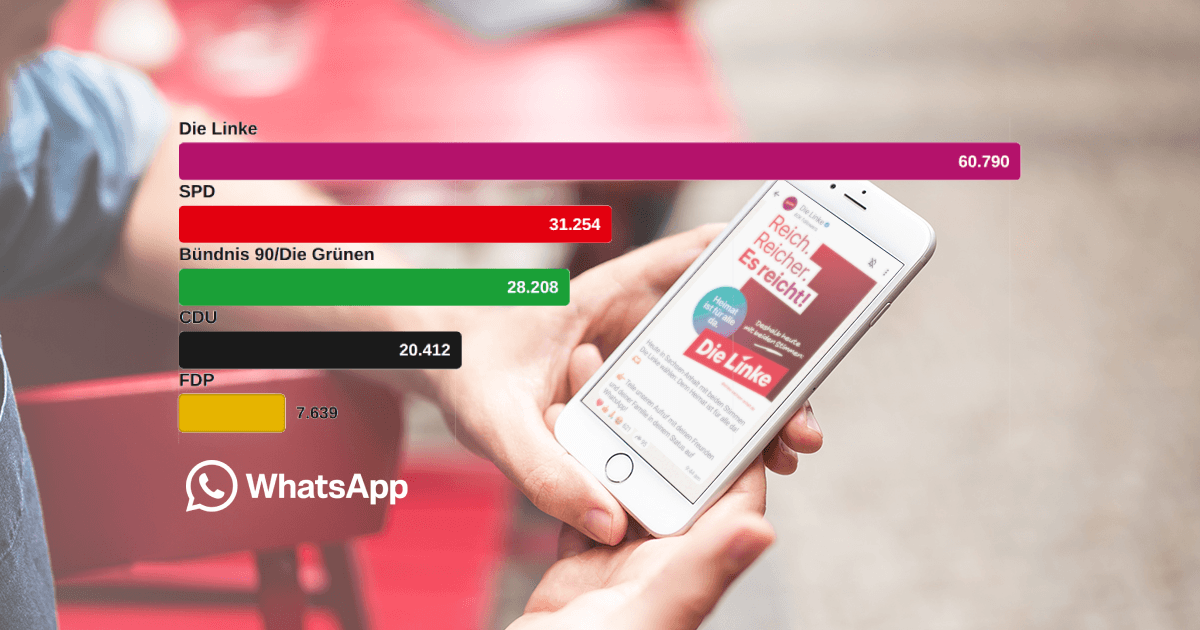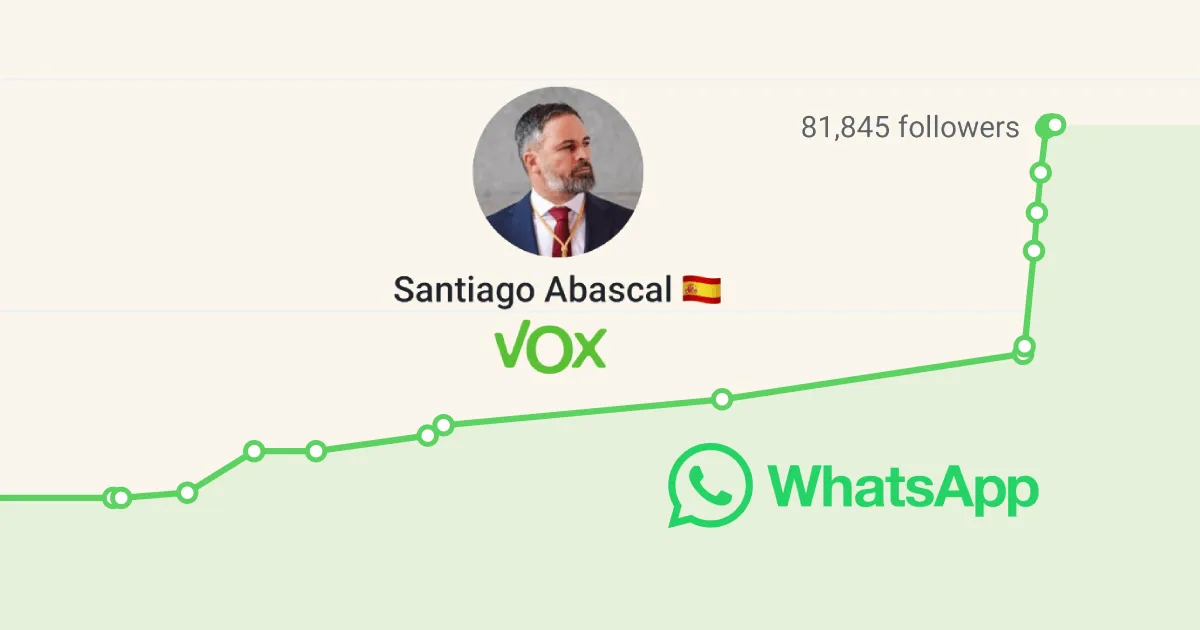
VOX's official channel is called "Santiago Abascal". It is the personal channel of the party's leader, verified, and in practice it works as VOX's main megaphone on WhatsApp: the party links to it from its website and its social accounts. On 28 August, when we started reading it daily, it showed 37,738 followers, the fourth-largest party channel in Europe among the ones we track, behind Italy's Movimento 5 Stelle, Die Linke and the Lega. Twelve days later it is close to 82,000, and it is first. It has overtaken half of Europe in a little over a week and a half.
See the ranking of Spanish parties on WhatsApp → Check where VOX stands and how the other parties are moving, with up-to-date figures.
A jump like that is worth stopping to look at. We have looked, with everything we have, and there are two ways to read it. One is that the Ceuta crisis pushed tens of thousands of real people to follow the channel. The other is that a good part of those new followers do not behave like the audience that was already there. The numbers cannot hand us a verdict, but they lean toward the second.
At WhaTools we track the official WhatsApp channels of every party in Europe and read their public follower counts on a schedule. Every follower reading here is in the open dataset. The per-post engagement figures are not: we counted those by hand for this article, and we explain how below.
The rise
This is the part that measures itself. Since the channel started being read daily, the count went like this:
| Date | Followers | Change |
|---|---|---|
| 28 Aug | 37,738 | |
| 29 Aug | 39,206 | +1,468 |
| 3 Sep | 57,590 | +18,384 |
| 5 Sep | 64,929 | +7,339 |
| 7 Sep | 72,659 | +7,730 |
| 10 Sep | 81,263 | +8,604 |
| 11 Sep | 81,842 | +579 |
| 13 Sep | 81,871 | +29 |
| 15 Sep | 81,851 | −20 |
| 16 Sep | 81,697 | −154 |
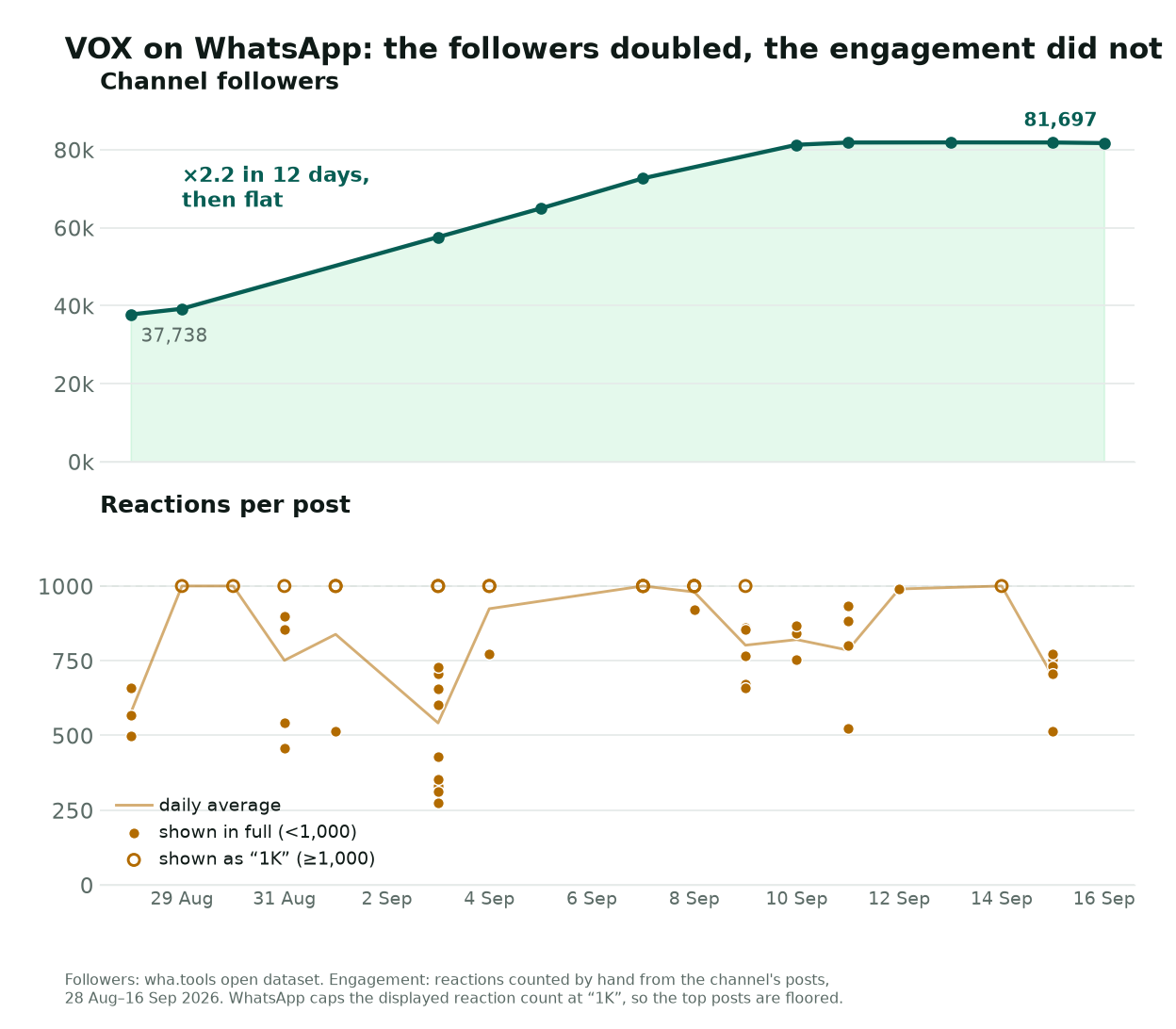
This growth is abnormal from the outset. For almost two weeks the channel adds between 3,000 and 4,000 followers a day, one after another, almost in a straight line. Then, around 10 September, it stops dead. From thousands a day to almost nothing, with no transition.
That shape is what gives pause. When a news story really drives a channel, the curve jumps and then eases off as the story cools. It goes up like a rocket and lands in a glide. There is no glide here. There is a steady twelve-day ramp and a hard stop. A rise that regular, ending that abruptly, fits something switched on and off more than it fits human attention.
From fourth place to the top of Europe
Those 42,000 followers do not just double the channel: they put it in front. We track the official channels of parties across Europe, and at the end of August VOX was fourth by followers, behind Italy's Movimento 5 Stelle, Die Linke and the Lega. On 15 September it is first.
| Rank | End of August | 15 September |
|---|---|---|
| 1 | Movimento 5 Stelle (IT), ~77,000 | VOX (ES), 81,851 |
| 2 | Die Linke (DE), 60,831 | Movimento 5 Stelle (IT), 76,976 |
| 3 | Lega (IT), 50,232 | Die Linke (DE), 62,658 |
| 4 | VOX (ES), 39,206 | Lega (IT), 49,981 |
| 5 | Italia Viva (IT), 34,455 | Italia Viva (IT), 34,325 |
It is worth being precise about what "in Europe" means: first among the parties we track, about seventy-five with a follower reading. Our coverage is complete in countries like Germany and uneven elsewhere, so it is not a census of every party on the continent. And VOX leads by a little, around 5,000 followers ahead of the Movimento 5 Stelle. Even with those caveats the move is large. The rest of the table shifts by hundreds of followers a week; VOX added tens of thousands in the same span and jumped over three established parties. A party does not usually go from mid-table to the top of the continent in twelve days on its own.
Ceuta explains part of it, but not all
The easy explanation is Ceuta. Almost every post on the channel in these weeks is about it: the crisis, the government, the security figures. It is heavy content, the kind that travels. And there is no doubt some of the rise is real: a subject like that brings genuine followers.
The Ceuta content starts in mid-August, but the steepest part of the rise we can measure precisely lands in the first week of September, weeks after the news peaked. For mid-August we only have scattered readings recovered from the Internet Archive, so we cannot reconstruct what happened then hour by hour. What we do measure cleanly, from 28 August on, is a rise that does not track the news cycle. It runs behind it, and with an odd regularity.
None of this proves anything on its own. But when the engine that is supposed to explain the rise (the news) was already fading while the rise kept going at full speed, it is worth checking the other side: what those new people do once they follow the channel.
What did not rise: engagement
This is where it gets interesting, and where you have to tread carefully, because WhatsApp's engagement data has a catch.
WhatsApp shows the reactions and forwards on each post, but it caps the figure at "1K". Any post with 1,000 reactions or more just shows "1K", without saying whether it is 1,000 or 1,300. So on the strongest posts we cannot see the real ceiling. To avoid fooling ourselves, we compared only the posts whose figure shows in full, below a thousand, at both ends of the period.
By that measure, here is what comes out:
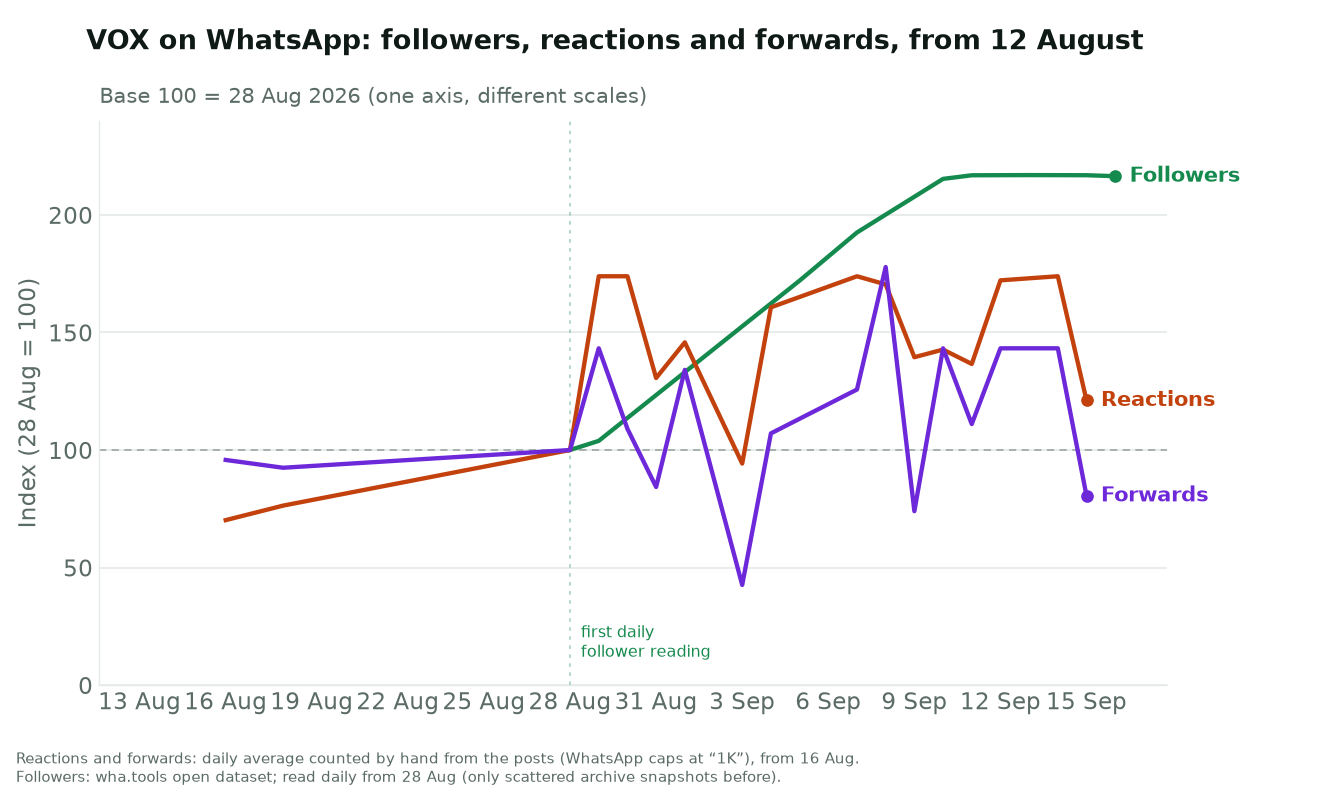
- Before the rise (channel at ~37,000 followers): the uncapped posts average 510 reactions. That is 13.8 reactions per 1,000 followers.
- On the plateau (channel now at ~82,000): they average 772 reactions. That is 9.4 per 1,000 followers.
So: followers multiplied by 2.2, but reactions (counting only what shows in full) by 1.5. Engagement per follower dropped about 30%, from nearly 14 to under 10 per thousand.
Forwards, which cost more than a reaction because they mean pulling the message out of the channel and into a chat, look worse still. The average of uncapped forwards does not even rise with the audience: it sits at 539, below the 655 from before the rise. Per follower, forwarding collapses from almost 18 to under 7 per 1,000.
Put plainly: about 42,000 new followers arrived, and the channel does not react or forward the way it did with half as many people. If those 42,000 were the same kind of audience that already followed Abascal, you would expect engagement to climb roughly in step with followers. It did not.
Why that points to fake followers
A fake follower, bought or inflated, does one thing: it adds to the counter. It does not react, it does not forward, it does no engagement. When many come in at once, the result is exactly what we see: the follower count rises and engagement stays flat, so engagement per follower falls.
It is the classic pattern of an inflated audience, and here the two signals that usually travel together show up at the same time: a growth curve too regular that ends abruptly, and engagement that does not keep the counter's pace. On their own, each has innocent explanations. Together, and in the same two weeks, they are harder to wave away.
WhatsApp is becoming the new online battleground for political parties. Last week we looked at the situation in Germany, where WhatsApp plays a real part in public life and, by extension, in the elections coming up in the next few weeks in Berlin. The race onto WhatsApp has barely started in politics and campaigning. We once looked at the techniques Bolsonaro used to "spam" thousands or millions of people over WhatsApp. That kind of spam is no longer so easy to pull off: Meta, which owns WhatsApp, is tightening its anti-spam systems, and so parties are leaning more on running their own verified channels and a constellation of groups and communities. In Brazil, where that 2018 playbook was born, PT now leads PL on WhatsApp by almost two to one.
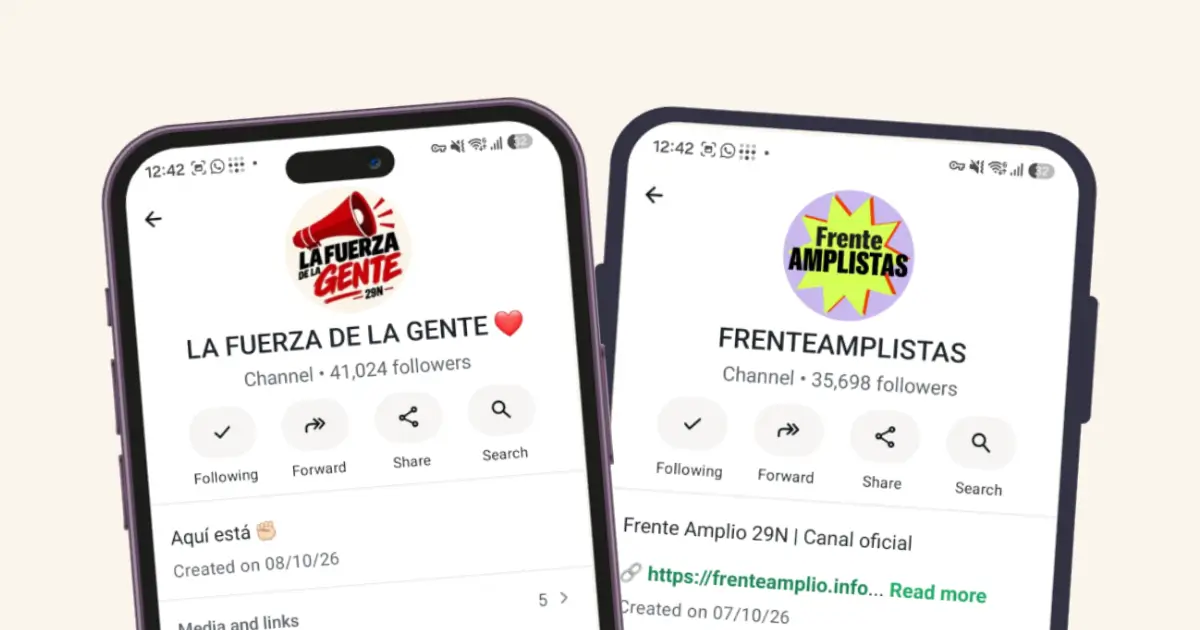
Update, 29 October: a month before the election, VOX's channel has barely moved, while two left-wing channels have taken off with growth that does look organic. We compare them in How PSOE and Frente Amplio are copying Lula's WhatsApp playbook.
How we did this analysis
None of this is proof, and it would be dishonest to sell it as such. There are three solid reasons to slow down before drawing conclusions.
First, the "1K" ceiling. Because we cannot see the high figures, it is possible the real engagement on the strongest posts rose more than we can measure. Our calculation stays with what shows in full, and that leaves out exactly the best posts.
Second, and this is the most important one, the Ceuta effect on the base that was already there. A crisis this intense does not only bring new followers: it rattles the people who already followed the channel and makes them react more. The entire rise in engagement we see could come from the usual 37,000 reacting twice as much because of the crisis, without a single one of the new followers lifting a finger. With the data we have, that scenario and the fake-follower one produce almost identical numbers, and we have no way to tell them apart from the outside.
Third, WhatsApp is not Twitter or Instagram. Following a channel requires an account with a real phone number, so the market for fake followers is smaller and more expensive than on other networks. It is not impossible, but it is not as easy as ordering 40,000 followers for four euros.
There are two ways to turn the suspicion into an answer, and neither is in this data yet.
The clean one is per-post views, which WhatsApp also shows. If views had doubled along with followers, the new ones are real people who at least open the channel. If views stayed where they were while the counter doubled, that no longer has a kind reading. We do not have them collected; it is the next thing to look at.
The other is to wait. Once Ceuta cools off completely, if engagement returns to August levels while the counter stays stuck at 81,000, we will know the rise in reactions was the old base stirred up by the crisis, and that the 42,000 new followers are, at best, a dormant audience. We are following it.
The follower figures come from the channel's public preview page, read on a schedule; daily since 28 August. The points before mid-2025 are recovered from Internet Archive snapshots and are rounded. That whole history is open under CC BY 4.0 in the dataset.
The engagement data is different, and it is worth saying so clearly: it is not part of the open dataset and does not come from any automated tracking. For this article we counted by hand the reactions and forwards of the channel's 56 posts between 28 July and 12 September, as WhatsApp shows them, with the "1K" cap the app itself imposes. It is a snapshot of a single channel made for this piece, not a series we maintain. Anyone can repeat the count by opening the channel.
Download the data
The two datasets behind this article, as CSV: