On Monday 5 October, the morning after the first round, Lula was behind. Flávio Bolsonaro had 47% of the vote and Lula 45%, and no candidate who led a Brazilian first round had ever lost the runoff. That morning a WhatsApp channel called Exército do Lula ("Lula's Army") had about 55,000 followers.
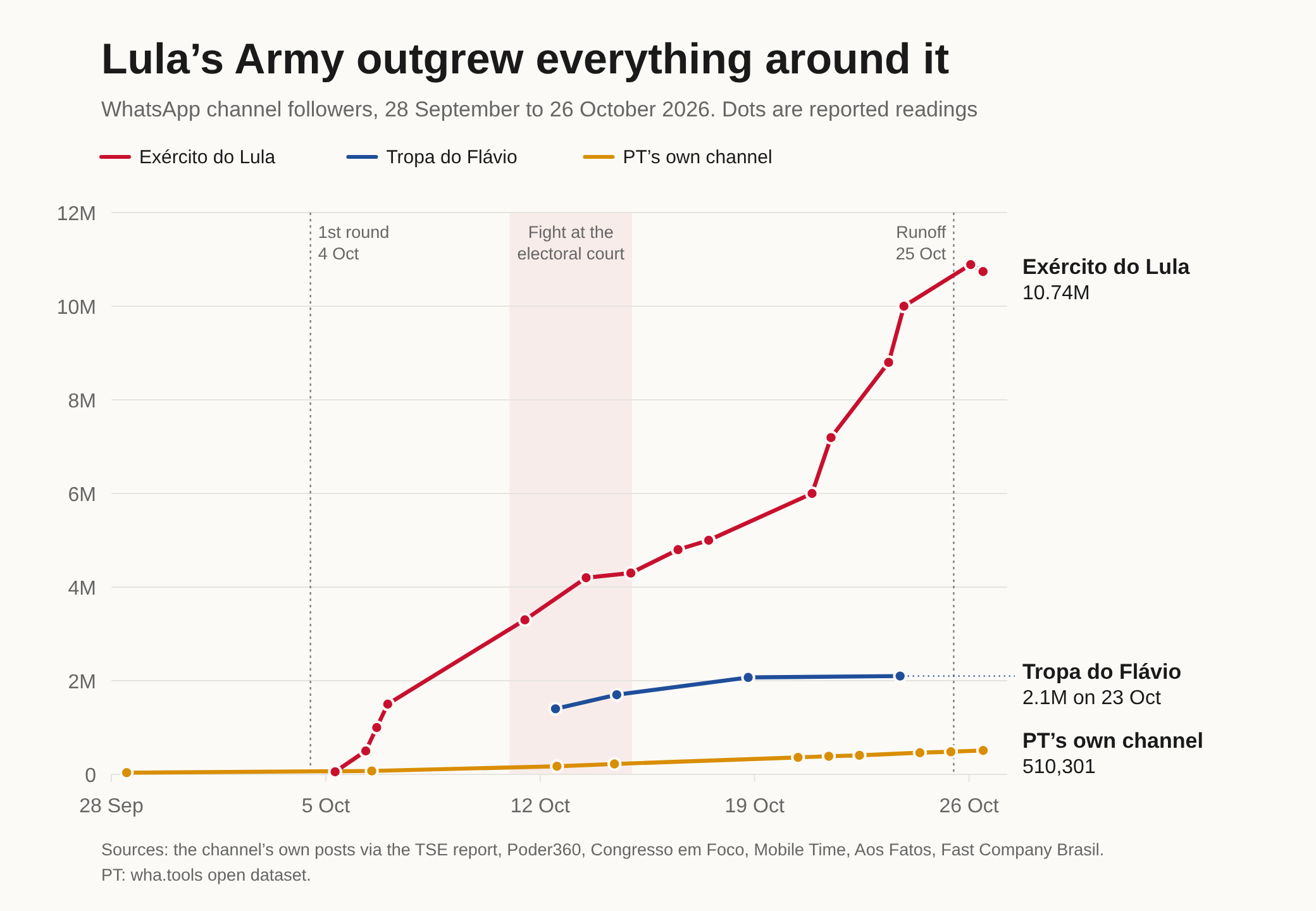
Three weeks later it had more than 10 million. It was the second-biggest WhatsApp channel in Brazil, behind a channel that posts sticker packs and ahead of Netflix Brasil. On Sunday Lula won with 51.79%, and on Avenida Paulista that night he told the crowd: "Vou conversar com vocês pelo canal do Janones." I'll talk to you through Janones's channel.
We write about WhatsApp and politics all the time, and we have not seen anything like this, on the left or the right, in any country we follow. So we went through as much of it as we could: the 21-page technical report that the electoral court's disinformation office wrote about the channel, three weeks of Brazilian coverage, and our own readings of the parties' official channels. Some of what we found is brilliant organizing. Some of it made us wince. We'll say which is which.
From 55,000 to 10 million
The channel wasn't new. It was created in April and had been posting since at least September, but almost nobody was paying attention. On 5 October, André Janones, the federal deputy who runs it, sent an audio message with a target: half a million people within a week, by the following Monday. "Pra começar cada um vai trazer três pessoas pra cá." To start, each of you brings three people here.
They didn't need the week. The next morning at 7:19 the channel posted "SOMOS MEIO MILHÃO AQUI!" (we're half a million here), and a minute later "ONTEM A ESSA HORA ÉRAMOS 55 MIL!" (this time yesterday we were 55,000). At 15:55 the same day it passed a million.
| Date | Followers | Source |
|---|---|---|
| 5 Oct, morning | about 55,000 | the channel's own post |
| 6 Oct, 07:19 | 500,000 | the channel's own post |
| 6 Oct, 15:55 | 1 million | the channel's own post |
| 7 Oct, 00:32 | 1.5 million | the channel's own post |
| 11 Oct | about 3.3 million | channel profile, TSE report |
| 14 Oct | 4.3 million | back online after the suspension |
| 17 Oct | 5 million | Poder360 |
| 21 Oct, 11:52 | 7,193,569 | Congresso em Foco |
| 23 Oct | 10 million | Mobile Time, O Globo |
| 26 Oct, morning | about 10.74 million | our read of the channel page |
The part we find most interesting is that WhatsApp didn't hand it those followers. Mobile Time checked and found that neither campaign channel appeared in any of WhatsApp's channel directory lists (most active, most searched, new). You had to know the name and search for it. The growth came from people sending the link to other people.
The tool for that was an invite text, and it was written in the follower's voice: "Acabei de entrar. Gente, entra!" (I just joined. Everyone, get in!), followed by the pitch that Janones wanted to build a "Comando unificado de redes sociais", a unified social-media command, for the final weeks. By 11 October that one message showed 344,000 forwards. It arrives in a family group looking like it came from your cousin, because it did.
When VOX's channel doubled in twelve days, the reactions and forwards per post stayed flat, and we asked whether those followers were real. Here the counters went the other way. Whatever else you think of Exército do Lula, its audience was doing things.
Who is André Janones
Janones is a 42-year-old lawyer from Ituiutaba, in Minas Gerais, who once worked as a bus conductor. He became famous in 2018 as one of the self-declared leaders of the truckers' strike, and that year he was elected to Congress with 178,660 votes. In 2020 he grew his online audience campaigning for the R$600 pandemic emergency payment.
In 2022 he launched a presidential pre-candidacy, dropped it on 4 August in a live broadcast with Lula, and became one of the loudest voices in Lula's digital campaign. Loud enough that the electoral court (the TSE) ordered several of his posts taken down that year, including ones saying Bolsonaro planned to cut the minimum wage and pensions and others calling Roberto Jefferson Bolsonaro's campaign coordinator. In the Jefferson case Alexandre de Moraes set a fine of R$100,000 for each new post on the subject.
This year he switched parties, from Avante to Rede, and on 4 October he was re-elected with 78,780 votes, about a third of his 2022 total. The channel's big growth came only after his own race was over.
He had told everyone what he planned to do. In June, at the PT's launch of a program to organize its online activists, he told them not to rebut accusations but to change the subject and "criar versão dos fatos", create a version of the facts. Asked about it, he said this meant telling another story from another angle, not lying.
How the army worked
The channel's description is one line: "Ative o sininho para receber as missões!" Turn on the bell to get your missions. WhatsApp mutes channel notifications by default, so a channel is normally something you scroll through when you feel like it. Asking millions of people to unmute it turns a channel into an alarm.
Then the missions came at set times. On 11 October at 8:40: "Missão do dia às 09:00 em ponto! Se preparem!" (Mission of the day at 9:00 sharp! Get ready!). At 9:00: "MISSÃO 01: SUBAM LÁ NO X A HASTAG: #LULANAPAULISTA". Fifteen minutes later the channel posted a screenshot of X's trending list with #LULANAPAULISTA first and #EXERCITODOLULAEMCAMPO second, and Janones followed with an audio claiming four of the top five topics in the country. The TSE's analysts couldn't verify that screenshot, but the pattern is clear enough: order, deadline, screenshot of the result, next order.
Reactions worked as a roll call. "Vocês têm 24 horas pra cumprir essa missão! Combinado? Se sim, coloca coração nessa mensagem aqui pra eu ver." You have 24 hours. If you're in, put a heart on this message. It got 14,000 reactions. Followers can't reply in a channel, so reactions and polls are about the only feedback an admin gets.
The channel handed out texts ready to send. "Fiz 3 modelos de textos aí pra vocês só encaminharem no WhatsApp." I wrote three texts for you to just forward. The channel was the hub, and followers' own chats, groups and broadcast lists were where the content was meant to land.
Sometimes the order was to do nothing. On 9 October, about a story in Veja magazine: "IGNOREM ESSE ASSUNTO! NÃO DESMINTAM, NÃO DEFENDAM O PRESIDENTE, não comentem, não engajem, nem leiam nada sobre isso. Apareceu no feed? IGNORA!" Don't debunk it, don't defend the president, don't even read it. That message was forwarded 79,000 times. Starving a story of engagement is an underrated move, and we've rarely seen it done this openly.
Most of the work happened off WhatsApp: Instagram videos to like and share, hashtags on X, searches on Google. Fast Company Brasil counted the posts on both campaign channels from the afternoon of the 18 October TV debate until it ended: 179 from Exército do Lula against 68 from Flávio's channel. Janones's were mostly instructions. Push #LulaDandoShowNaBand, post on Instagram, Threads, Facebook, X and Bluesky, don't engage with right-wing posts or the press. A clip of Lula pressing Flávio about a property purchase got 64,700 reactions and 115,000 forwards. A photo of Janones at the TV studio, captioned "General chegou tropa sintam-se representados" (the general has arrived, troops, feel represented), got 259,000 reactions.
On 17 October the mission was to take the flag back. "O verde e amarelo é nosso": wear green and yellow and the Seleção shirt, colours the Bolsonaro movement had made its own. Lula posted a photo of himself in the yellow shirt with "Bora, Brasil!", and Janja, Geraldo Alckmin and several ministers joined in.
By the last week Lula was in the channel himself. On 23 October he sent a video celebrating 8.8 million followers: "Quero ver se a gente chega, depois do debate, a 10 milhões de soldados." It hit 10 million that day.
The parts that should make you uneasy
We like a lot of this. We don't like all of it, and pretending otherwise would make this a press release.
"Share it before you watch it"
On 8 October the channel posted a burst of messages: "CURTAM COMENTEM LULA REELEITO E COMPARTILHEM ANTES MESMO DE ASSISTIR", then "PRA SINALIZAR PRO ALGORITMO QUE O CONTEÚDO É RELEVANTE", then a link and "EXPLODAM". Like, comment and share it before you've even watched it, to tell the algorithm it matters. The TSE's analysts singled this one out. WhatsApp's protections against viral misinformation, forward limits and the "forwarded many times" label among them, assume people look at what they pass on. An instruction to skip that step works against them, whatever's in the video.
The Google push
On 22 October the channel sent followers to search for "Bolsonaro Talvane Albuquerque". The facts behind it hold up: Talvane Albuquerque was a deputy from Alagoas convicted in 2012 for the 1998 murders of deputy Ceci Cunha and three members of her family, and in 1999 Jair Bolsonaro was one of 29 deputies who voted against stripping him of his seat. Searches passed 200,000. But the point of the mission was to weld a surname to a murder in the search box, three days before the vote.
Both sides used the trick. On debate night, at 21:45, Flávio's channel told its followers to Google terms attacking Lula and his family. At 22:10 Janones did the same about Flávio.
Deleted messages
Janones said he deleted more than 500 messages after each mission to keep the channel tidy. According to the court file, messages from late September were deleted from 7 October on, and 81 more disappeared before anyone could read them. A public channel is only as accountable as its history, and this one kept rewriting it.
The September posts
The case Flávio's campaign brought was about posts from 10 to 28 September claiming Flávio would remove Nossa Senhora Aparecida as Brazil's patron saint, was involved with militias, would cut pensions and the BPC benefit for poor elderly and disabled people, and had ordered a Bolsa Família rise cancelled. His campaign called them false. Janones denies ever spreading fake news, and on 8 October the channel promised there wouldn't be "UMA ÚNICA FAKE NEWS ATÉ O FINAL DA CAMPANHA". The TSE office found none of the contested claims repeated in the posts it checked from 2 to 11 October.
The tone, and the cost
The court report describes the language as all caps, exclamation marks, soldiers, missions and "sangue nos olhos" (blood in the eyes), us against them. On 16 October Janones sent an audio asking followers to skip lunch, dinner, dates and showers if they had to. Two days later, after the TV debate, he was in intensive care with a cardiac arrhythmia. He said he'd been sleeping two or three hours a night for two weeks and travelling by car so he could stay online. The channel went quiet for 19 hours. When millions of people wait for one man's next message, the whole operation depends on one man's heart.
The fight at the electoral court
The other side tried to take it down almost immediately. On 6 October, SBT News reported, PL's communications team and right-wing influencers met by video call and started mass-reporting the channel. On 7 October Flávio's campaign went to the TSE.
What followed was a mess:
- 11 October: TSE president Kassio Nunes Marques suspended the channel. Hours later the electoral inspector-general, Ricardo Villas Bôas Cueva, overturned it for lack of evidence. The takedown was never carried out.
- 13 October: Nunes Marques suspended it again, this time because Lula's campaign had never formally registered the channel's address with the electoral court. The campaign registered it, and the channel was back online the night of 14 October.
- 16 October: the TSE unanimously approved new rules: a WhatsApp channel counts as linked to a campaign if it meets any one of six criteria, such as campaign money, campaign staff or the link appearing on official profiles. Linked channels must be registered and can be switched off until they are. Spontaneous support alone doesn't count.
- 21 to 22 October: a draft rule by justice André Mendonça came out that would switch off every political channel with more than 200,000 followers for the 48 hours before and 24 hours after the runoff. Nunes Marques left it for after the election. He did order Meta to review the channel and report back within 24 hours.
When the takedown request came in, Janones called it "mais do que censura", more than censorship: "uma ditadura". After the second suspension he told followers not to attack the minister or the courts, and said Flávio's lawsuit had helped the channel reach 4.3 million. Between the first suspension and the channel's return it did gain about a million followers. The backup plan, a Telegram channel the Army pointed people to as the suspension loomed, had about 109,000 subscribers on 11 October, around 3% of the WhatsApp audience. Almost nobody followed.
The other army: Tropa do Flávio
Flávio's side had its own channel, Tropa do Flávio, run by deputy Nikolas Ferreira (PL). It went from about 1.4 million followers on 12 October to 2.1 million on 23 October. A big channel by any normal standard, and a fifth the size of Janones's.
It worked differently. On debate night it posted short video cuts of Flávio, several edits of the same moment with dramatic music, and orders like "bora pra guerra" (let's go to war) and "manda pra todos os grupos e listas" (send it to all your groups and lists). It was built to be forwarded into groups, the 2018 way. Aos Fatos counted 17 misleading or distorted posts in its first week, about 2.4 a day, including an image altered with AI and passed off as a real photo taken after a pro-Lula rally. After Erika Hilton (PSOL) asked the TSE to apply the same registration rule, Flávio's campaign registered it too.
One more odd detail. On 14 October, Congresso em Foco found that searching "Exército do Lula" in WhatsApp suggested Tropa do Flávio, but searching "Tropa do Flávio" didn't suggest any Lula or PT channel. We haven't seen an explanation from Meta.
What happened to the parties' own channels
We track the official WhatsApp channels of political parties, not movements, so Exército do Lula isn't in our dataset and won't be. But the parties' channels in Brazil moved too, and the numbers are wild.
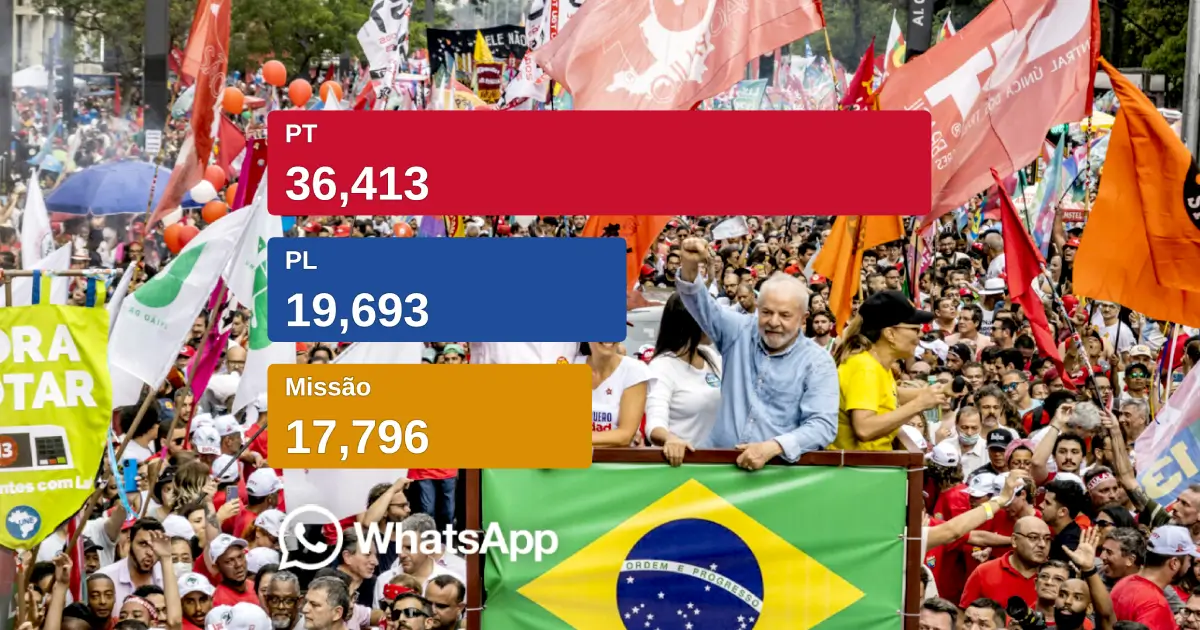
A month ago we wrote that PT was Brazil's most-followed party on WhatsApp, with 36,413 followers. Here is what happened next:
| Party channel | 28 Sep | 11-12 Oct | 20 Oct | 26 Oct |
|---|---|---|---|---|
| PT | 36,413 | 172,841 | 363,287 | 510,301 |
| PL | 19,693 | 23,619 | 28,375 | 29,888 |
| Missão | 17,796 | 21,189 | 22,875 | 22,951 |
PT's channel grew fourteen-fold in four weeks. We can't tell how many of those people came through Janones's channel, but the two curves take off in the same week. PL's grew by half. Missão, which was catching up with PL in September, has been flat since mid-October.
Even so, Janones's channel ended the campaign about 21 times the size of PT's own channel, and Tropa do Flávio about 70 times the size of PL's. In 2026 the big WhatsApp audiences belonged to people, not parties.
Did it win the election?
Nobody can measure that, and we're suspicious of anyone who says they can. A follower is a potential reader, not a view and not a vote. Ten million followers is a lot, but Lula got 64 million votes.
What we can say: Lula went from two points behind to winning by 3.6 points, 4.43 million votes. On 21 October, with a Quaest poll showing Flávio 45 and Lula 44, Quaest's intelligence director Guilherme Russo said: "O que o Janones está fazendo não tem precedente no Brasil, especialmente vindo da esquerda." What Janones is doing has no precedent in Brazil, especially coming from the left.
After he left hospital, Janones changed course in public. Attacks on Flávio weren't working, he said, "a gente já viu no primeiro turno que isso não dá certo", and the last five days should go to undecided voters, people who skipped the first round, and people who vote Bolsonaro without being bolsonaristas. Turnout went from 78.92% in the first round to 80.78% in the runoff. We can't tie that to the channel. It's the group he said he was going after.
What happens to it now
Janones isn't shutting it down. In an audio on Monday he called the win a "construção coletiva" (a collective effort), promised everyone "dois dias de folga" (two days off), and said the missions would come back, with a new target of 12 or 13 million followers. The next goal, he said, is getting Lula to 90% approval. About people leaving: "Está diminuindo aí um pouquinho o número de inscritos, é normal, são os infiltrados saindo." It's the infiltrators leaving.
Lula said on Sunday night he'd stop talking to his supporters "via interpretação da imprensa", through the press's interpretation, and use the channel instead. A sitting president with a ten-million-person push channel run by a congressman is new for Brazil. The TSE put off its debate on rules for big political channels until after the vote, so that comes next.
If you run a campaign and want to try this at a smaller scale, our guide to WhatsApp channels for political and social organizations covers the setup. For how Brazil got here, from the mass messaging of 2018 to this, we wrote a companion piece on WhatsApp and Brazil's elections from 2018 to 2026.
When we checked the channel on Monday morning, it showed about 10.74 million followers, roughly 150,000 fewer than at one in the morning.
How we put this together
The follower milestones come from the channel's own posts (as recorded in the TSE report) and from Brazilian press coverage, linked above. Our own reading of the channel page on 26 October came from WhatsApp's public preview page, which rounds counts this large in most languages. The quotes from the channel come from the TSE's technical report on it, written by the court's Special Advisory Office for Combating Disinformation from public posts only. The party-channel figures come from the wha.tools open dataset, read from each channel's public page and published under CC BY 4.0.