On the night of 1 October 2025, the Israeli navy stopped the boats of the Global Sumud Flotilla in international waters, on their way to Gaza. Many of them had sailed from Barcelona a month earlier, and the people detained included the city's former mayor, Ada Colau. Within hours there were hundreds of people outside the Israeli consulate on Avinguda Carles III, and the flotilla's organizers were calling for protests the next evening in every town in Catalonia.
If you were in Catalonia that week and wanted to show up, the hard part was finding out where. The information was spread across Instagram stories, Telegram channels and family group chats, and half of it was out of date by the time it reached you. One WhatsApp number tried to fix that. You wrote to it and it told you what was happening with the boats and where the nearest protest was.
The bot was called Solidaritat amb Palestina (Solidarity with Palestine). In its first 48 hours it signed up more than 1,000 people.
Who built it
The bot is a project of procom.dev, a Barcelona collective of developers who write software for social movements, NGOs and progressive organizations (the same team behind WhaTools). One of its developers announced it on LinkedIn on 2 October 2025, the day after the interception, with the first number: over 1,000 users in two days.
The argument for building it was simple. Social media decides who sees your post, and in a week like that one an algorithm can bury the call that matters. An email or a WhatsApp message lands in someone's inbox, where they will actually read it. So the bot went where people already were.
What the bot did
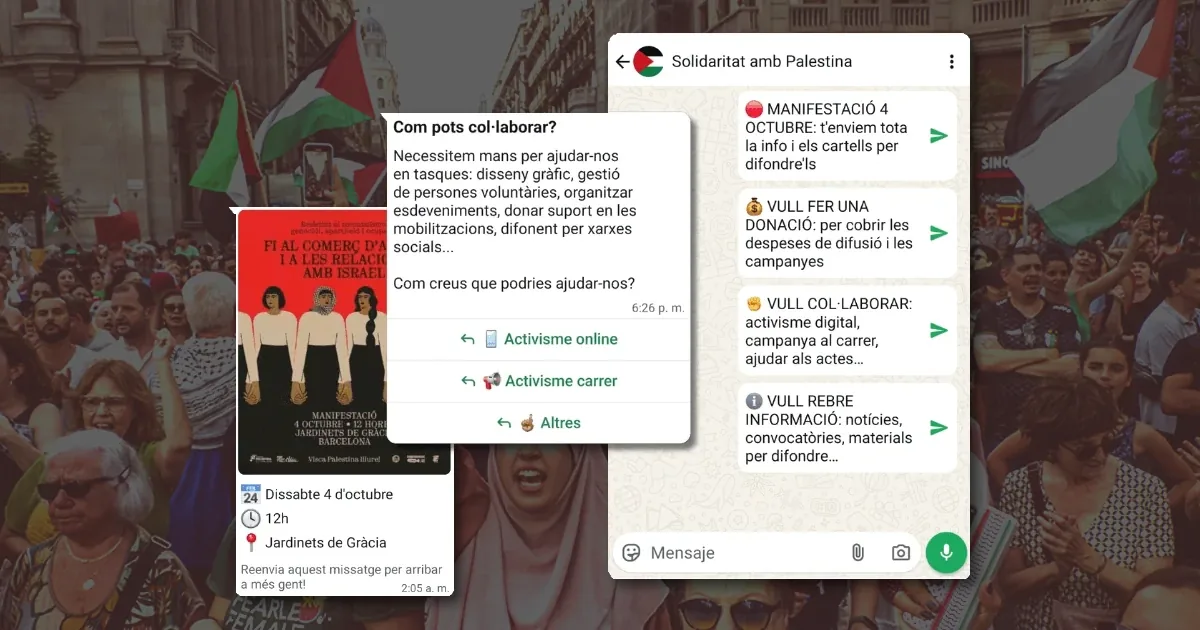
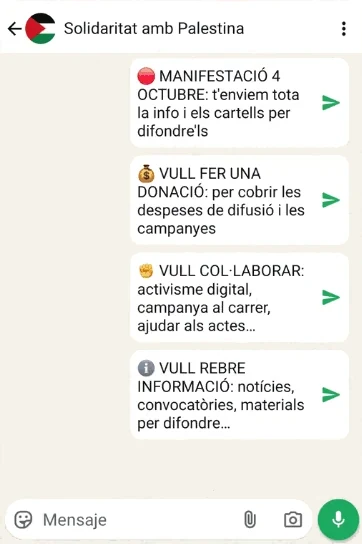
When you opened wa.me/34604865168, WhatsApp showed four suggested messages you could tap instead of typing (Meta calls them ice breakers). One sent you everything about the 4 October march, posters included, ready to share. One was for donations, to cover the cost of outreach and campaigns. One was for volunteering, and the last was for news, calls to action and materials to pass on.
The updates option carried the news that week: reports on the flotilla and the people on board, and urgent calls to protest. On 2 October alone there were gatherings in more than 40 Catalan towns, and the bot listed them. The volunteering option asked what you could take on (graphic design, coordinating volunteers, organizing events, helping at the mobilizations, sharing on social media) and sorted people with three buttons: online activism, street activism or something else.
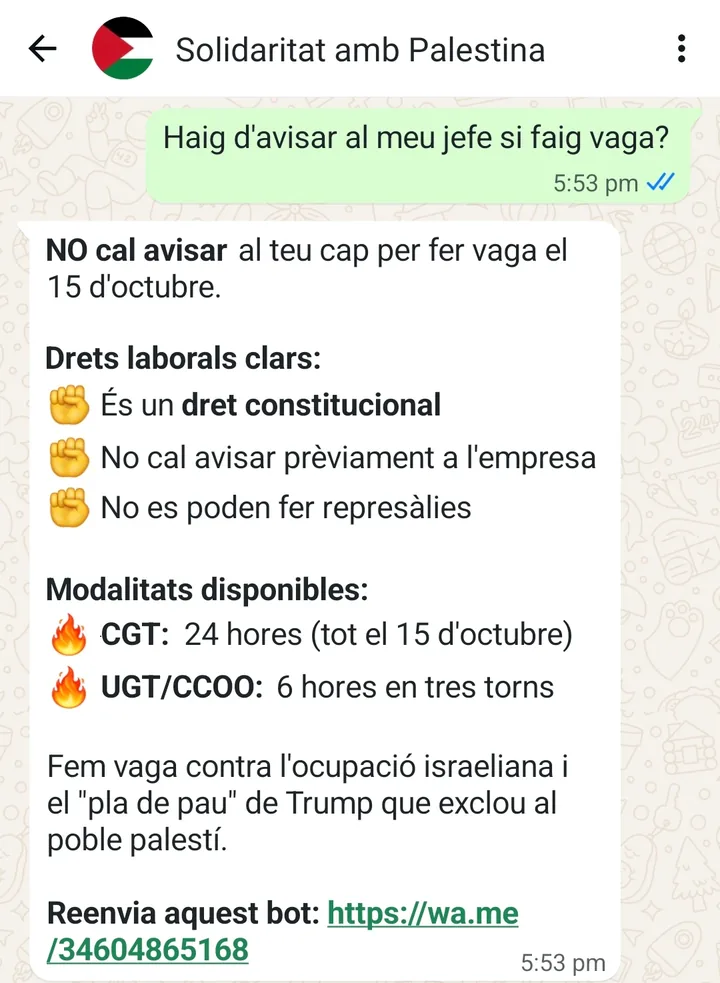
If your question wasn't covered, you could just type it. An AI model looked up the latest news on what you had asked and wrote back in the bot's own voice. Before the general strike for Palestine on 15 October, someone asked whether they had to tell their boss they were going on strike. The bot said no, explained the rights involved, listed what each union had called, and signed off with its own link and a request to forward it.
The march on 4 October was huge. The Guàrdia Urbana counted around 70,000 people walking from Jardinets de Gràcia to the Arc de Triomf, and the more than 600 organizations behind it said 300,000. A bot didn't fill those streets. But it was one of the ways people found out when to leave the house and which street to head for.
How it spread: 80% forwards
The bot had no ad budget. People found it the way they find most things on WhatsApp: someone sent it to them.
According to procom.dev's internal data, 80% of new users came from a forwarded link. Someone joined, saw it was useful and passed the wa.me link to their family group, their neighbourhood chat or their union branch. The rest came from collectives sharing the number, posts on social media and QR codes on posters and flyers at the protests.
The bot asked for those forwards. The message with the 4 October poster ended with "Reenvia aquest missatge per arribar a més gent!" ("Forward this message to reach more people!"), and the AI answers closed with "Forward this bot" and the link. A lot of people did exactly that.
That 80% figure is the most useful part of the story for anyone organizing. A click-to-chat link is easy to forward, and a forward from a friend works better than any post. If you want something to spread on WhatsApp, make the link the thing people share and put a reason to share it in the first reply.
After the first rush, the bot kept growing through the October mobilizations. The team puts the final count at between 2,000 and 5,000 users.
How it was built
There was no hack behind this. The bot ran on Meta's official WhatsApp Cloud API, with webhooks into procom.dev's own backend. Fixed menus handled the main flows (flotilla news, today's protests, the march, how to help), and the AI only came in when someone typed something the menus didn't cover. Keeping the important answers in menus meant the protest times people got were the ones a person had checked.
A small team of volunteers kept the information current. Partner collectives also sent in their own calls, and the bot passed them on. That split matters: the developers didn't have to know every protest in every town, because the people organizing them told the bot.
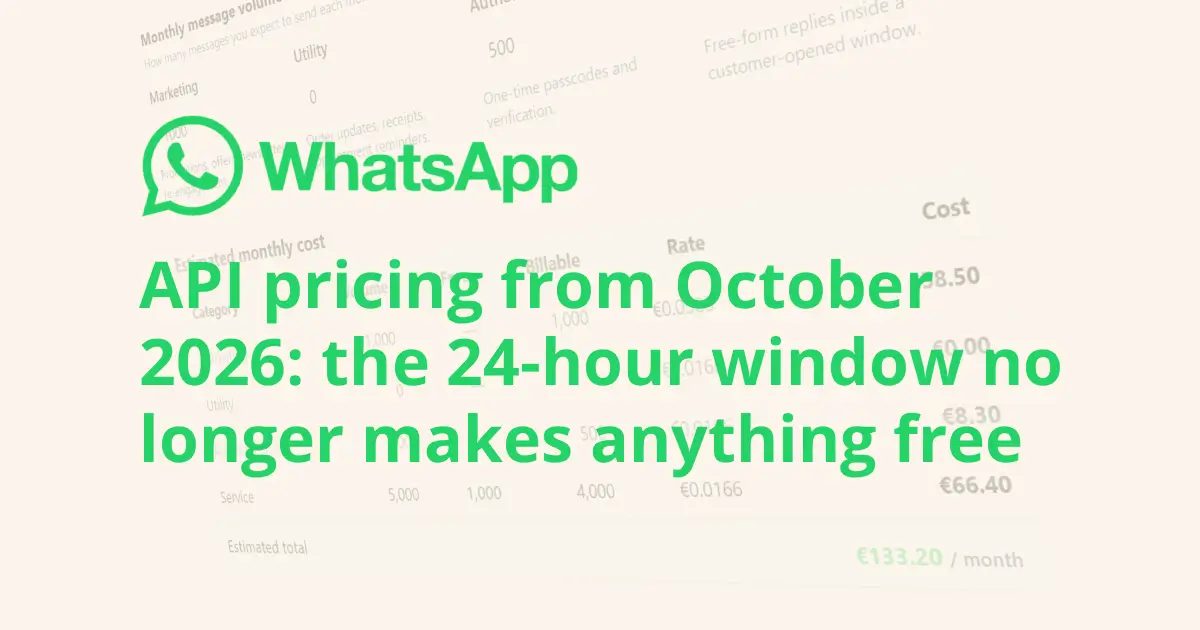
Sending messages was a mix. The Cloud API lets you reply freely inside a 24-hour window after the user writes to you, and in October 2025 those replies were free. Most of the traffic went that way, since everyone who used the bot had written to it first. For the big calls, sent to people who hadn't written that day, the bot used paid marketing templates. On the card in force then, a marketing message to a Spanish number cost $0.0615, so one alert to 3,000 people came to about $185. The donation option in the menu asked people to chip in for exactly that kind of cost.
That has changed since. From 1 October 2026, replies inside the window are no longer free once a number passes 1,000 a month, so the same bot would cost more to run today. You can work out the numbers for your own country in the WhatsApp API pricing calculator.
There's a catch for parties. Solidaritat amb Palestina wasn't a party, a candidate or an electoral campaign, which are the groups Meta's Business Messaging Policy shuts out of the platform. A party couldn't run the same thing on the official API. We go through what parties can do instead in how a political party can use the WhatsApp Business API.
Why a bot and not a Channel or a group
WhatsApp gives you free ways to reach a lot of people at once: groups, broadcast lists, Communities and Channels. We compare all of them in how to message many people on WhatsApp. So why a bot?
A Channel is one-way, muted by default and can't tell you which protest is closest to you. A group of a few thousand strangers turns into noise in an hour, and every member can see everyone else's number. A bot gives each person a private conversation. It answers the question they have, and it doesn't show their number to anyone. In a week when people were angry, scared for friends on the boats and asking the same ten questions, that worked well.
It has costs a Channel doesn't: someone has to build it, keep the backend running and pay Meta per message. For a short, intense campaign where people need answers, that can be worth it. For slow news, a Channel is cheaper.
What other movements can take from it
- Go where people already are. Nobody had to install anything or make an account. A wa.me link and a "hi" were enough.
- Ask for the forward. Four out of five users came from a forward, and the bot's messages ended by asking for one. The link and that closing line did more than any launch post.
- Let the organizers feed it. The collectives that called the protests sent them to the bot, so the information was current without the developers chasing it.
- Use menus for the facts and AI for the rest. A protest time should come from a person who checked it. The AI is there for the questions nobody predicted.
- Plan for the bill. On the official API, alerts to people outside the 24-hour window are paid templates. Budget for them before the crisis, not during it.
If you're working on something similar, our 6 best WhatsApp strategies for political campaigns covers chatbots alongside groups, Communities and Channels.
Where it is now
A year on, the bot is dormant. It still answers if you write to it, but it rarely sends anything out. The number, +34 604 865 168, still works, and the project page is still up in Catalan, Spanish and English. If the streets fill up again, it can be switched back on.
Cover photo background: Pedro Mata / Fotomovimiento, CC BY-NC-ND 2.0.