For almost two years, the 24-hour customer service window was the cheap part of the WhatsApp Business API. A customer wrote to you, and for the next 24 hours you could answer as often as you liked without paying Meta anything. From July 2025 the same went for utility templates, like an order update, sent inside that window.
Both ended on 1 October 2026. The window still matters, because a free-form reply can only be sent while it's open. But since that date, being inside it doesn't make any message free.
This post explains the card as it stands today. If you want the announcement itself, with the nine markets that went standalone and the rate rises Meta didn't announce, we covered that in what changes on 1 October 2026. All figures are Meta's fee per delivered message in US dollars, from its own 1 October 2026 rate card.
What a message costs now
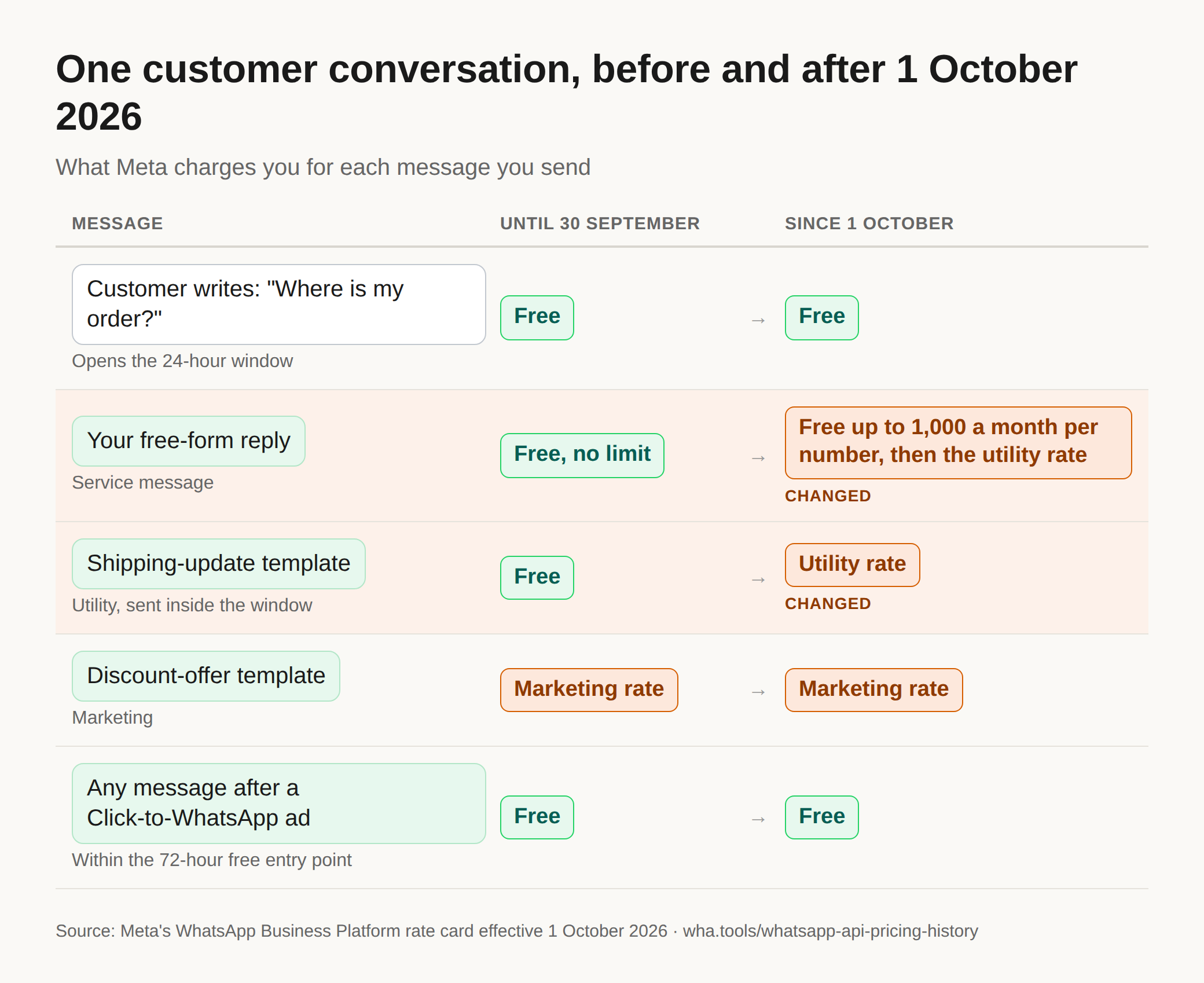
Meta prices four kinds of message. Each is charged per delivered message, at the rate for the recipient's country.
| Message | When you can send it | Until 30 September 2026 | Since 1 October 2026 |
|---|---|---|---|
| Service (a free-form reply, not a template) | Only inside a 24-hour window the customer opened | Free, no limit | First 1,000 a month per phone number free, then the utility rate |
| Utility template (order, booking or account update) | Any time | Free inside the window, utility rate outside it | Utility rate, inside or outside the window |
| Authentication template (one-time codes) | Any time | Authentication rate | Authentication rate, unchanged |
| Marketing template (offers, newsletters) | Any time, with opt-in | Marketing rate | Marketing rate, unchanged |
Two things stay free. The customer never pays to message you. And the free entry point survives: when someone reaches you through a Click-to-WhatsApp ad or a Facebook Page button, every message you send for the next 72 hours is free, as Meta's pricing page still says and its partner 360dialog confirmed for the period after 1 October.
Since July 2025 the utility and authentication list rates have been identical in nearly every market, and the service rate now matches them too. So in Spain, a free-form reply past the allowance, an order-update template and a login code all cost the same $0.02.
How the 1,000 free messages work
The allowance is counted per business phone number, not per account. It resets on the 1st of each month, and unused messages don't roll over. Message 1,001 onwards is billed at that market's utility rate. Meta's own pricing pages didn't mention the allowance when we checked them on 3 October. The figure comes from Meta partners 360dialog and Gupshup, whose notices agree on the number, the per-number count, the monthly reset and the lack of rollover.
From 2022 until October 2024 every account got 1,000 free service *conversations* a month. A conversation could hold dozens of messages. Today's allowance is 1,000 *messages*, so it runs out much sooner: a support chat that takes eight replies uses eight of them, so a ticket count will make the allowance look bigger than it is. The six-year pricing history has the full sequence.
What a month of support costs now
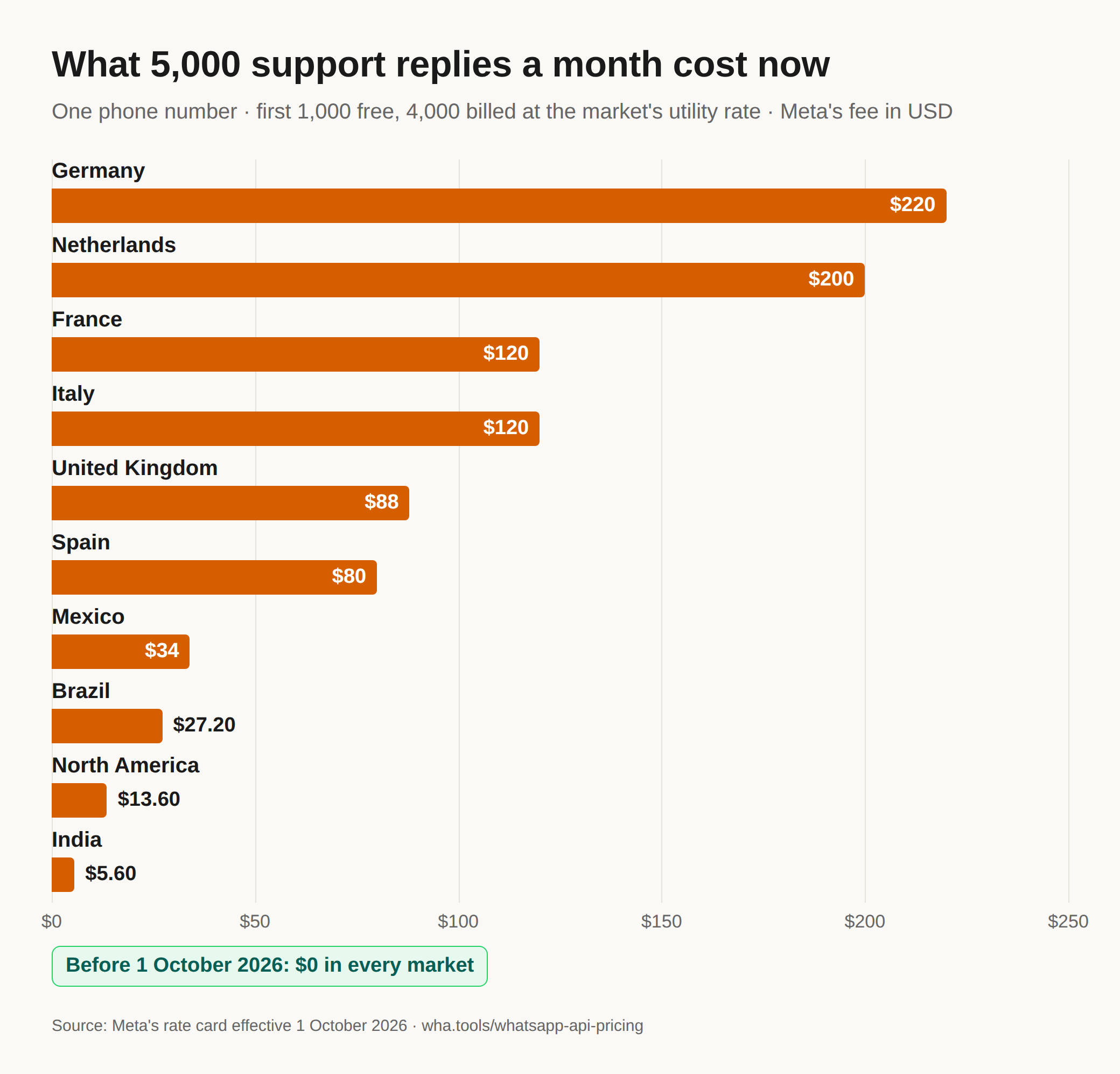
Take a business that sends 5,000 free-form support replies a month from one number. Until September that cost nothing anywhere. Now the first 1,000 are free and the other 4,000 are billed, so the price depends entirely on the country your customers are in.
| Market | Utility / service rate | 5,000 replies a month, one number |
|---|---|---|
| Germany | $0.055 | $220.00 |
| Netherlands | $0.05 | $200.00 |
| France | $0.03 | $120.00 |
| Italy | $0.03 | $120.00 |
| United Kingdom | $0.022 | $88.00 |
| Spain | $0.02 | $80.00 |
| Mexico | $0.0085 | $34.00 |
| Brazil | $0.0068 | $27.20 |
| North America | $0.0034 | $13.60 |
| India | $0.0014 | $5.60 |
Three worked examples:
- A small shop in Spain answers 600 questions a month and sends 300 order-update templates inside the window. The replies fit inside the free 1,000. The templates now cost 300 × $0.02 = $6 a month, up from nothing. For a business this size, the utility change matters more than the service one.
- An online store in Germany answers 4,000 questions a month and sends 2,500 shipping updates inside the window. That is 3,000 × $0.055 = $165 for the replies and 2,500 × $0.055 = $137.50 for the updates: $302.50 a month, up from nothing.
- The same store, if it runs two numbers (one per brand) and each handles 2,000 replies: each number gets its own 1,000, so the replies cost 2,000 × $0.055 = $110 instead of $165. The updates cost the same.
Each figure is Meta's fee only. A Business Solution Provider such as Twilio, 360dialog or Wati adds its own fee on top. To price your own mix, the WhatsApp API pricing calculator now has a service line that applies the 1,000 free messages for one number.
Who notices, and who doesn't
If a number sends fewer than 1,000 free-form replies a month and you don't send utility templates inside the window, your bill hasn't changed.
The change bites hardest on support-heavy numbers in expensive markets. Germany and the Netherlands charge more than $0.05 per message, so 10,000 replies a month cost $495 in Germany. Chatbots can cost more than expected: a bot that answers each question in three short bubbles sends three billable messages where one would do.
At the other end, the transactional rates in India ($0.0014), Colombia ($0.0008) and Turkey ($0.0009) are low enough that even heavy support traffic costs little.
What to change
- Check that a payment method is on file. 360dialog warned that Meta stops delivering service messages from an account with no payment method once they become chargeable. If your replies stopped going out on 1 October, start here.
- Count last month's service messages per number. WhatsApp Manager and most providers show this. If every number stays under 1,000, the service change costs you nothing.
- Send one complete reply instead of several fragments. Every delivered message is counted. That goes for automatic "we got your message" acknowledgements too, and for bots that split answers into bubbles.
- Inside an open window, consider free-form text instead of a utility template. A free-form message draws on the free 1,000 first, while a utility template is billed from the first one. Past the allowance, both cost the same.
- If you already run Click-to-WhatsApp ads, keep using them as an entry point. The 72-hour free window they open is unchanged.
- If you're very small, ask whether you need the API at all. The free WhatsApp Business app charges nothing per message. It suits one person or a small team, not automation at scale.
For how this quarter fits the longer pattern, see the pricing change history and the price-trends chart.