If you run WhatsApp for a ministry, a city council, a health charity or a disaster-relief group, here is the short answer: your replies to the people who write to you may still be free, with no monthly limit, until 31 December 2027. Meta calls this a policy for "eligible government and non-profit organizations".
There's a catch. Meta decides who is eligible, there is no way to apply yet, and the only way to know is to check a field on your account. Everyone else pays for replies past 1,000 a month per phone number.
Everything below comes from Meta's WhatsApp pricing page, which we re-read on 11 November 2026. Where Meta doesn't say something, we tell you that rather than guess.
What changed on 1 October 2026
A service message is a free-form reply, not a template, sent inside the 24-hour window that opens when someone messages you. From November 2024 to the end of September 2026, those replies were free and unlimited for everyone.
Since 1 October 2026 they cost money. Each business phone number gets, in Meta's words, "one free tier of 1,000 delivered service messages per month". From the 1,001st reply in a month you pay the same rate as a utility message in that person's country, according to Meta's rate card. Unused messages don't roll over.
For a busy helpline that adds up quickly. A number in Germany answering 5,000 messages a month now pays for 4,000 of them at $0.055 each, which is $220. Our guide to the October 2026 pricing has the figures for ten markets, and the WhatsApp API pricing calculator works out your own.
Who qualifies
Meta's page says: "Service messages remain free beyond the monthly free tier only for eligible government and non-profit organizations." It lists two groups:
- "Government departments and agencies; inter-governmental organizations"
- "Community non-profit organizations, including those in public health, crisis response, disaster relief" and "non-partisan civic engagement"
That is the whole list. Meta publishes no other criteria, so nothing on size, legal status or country. Political parties are not on it.
The policy applies "For organizations Meta has identified as eligible". If Meta had already identified you, it kicked in at midnight on 1 October 2026, in your Messaging account's timezone, so there was no gap.
How to check whether your account is exempt
Meta gives two signals. Both are technical, so if a Business Solution Provider (the company that connects you to the API) runs your setup, ask them to look.
Since 12 October 2026, the status updates Meta sends to your webhook for each message carry a subtype field in their pricing details. On a service message that was free because of this policy, it reads paid_exempt.
Since 23 October 2026 there is a simpler check: a service_pricing_policy field that your developer or provider can read on your WhatsApp Business account through Meta's API. PAID_EXEMPT means eligible. REGULAR means not.
An account showing REGULAR still gets the 1,000 free service messages a month on each number, like everyone else.
You think you qualify, but it says REGULAR
This is the frustrating case, and right now there isn't much you can do about it. Meta says it "is also building a way for Solution Providers and businesses to request a review of their eligibility and will provide an update once it is available." It hasn't given a date.
What you can do:
- Ask your Business Solution Provider. They can read the field for every account they manage, and Meta is building the review process for them as well as for you.
- Watch Meta's pricing page for the review process. That's where the announcement is promised.
- Budget as if you'll pay. Until your account shows
PAID_EXEMPT, every reply past 1,000 a month per number is billed. Price it with the calculator, and treat the exemption as a saving if it arrives, not something to plan around.
If your volume is well under 1,000 replies a month per number, none of this changes your bill anyway.
What the exemption doesn't cover
First, template messages. Meta's policy talks about service messages only. Marketing, utility and authentication templates, such as an appointment reminder, a newsletter or a login code, are billed as normal, at your market's rate, eligible or not. Meta doesn't say anywhere that the exemption reaches any other kind of message.
Second, anything after 2027. Meta says the policy "will be in effect through December 31, 2027", and nothing more. It hasn't said whether it will be renewed, changed or dropped. If your project runs past that date, plan for paid replies in 2028 unless Meta says otherwise.
For the full sequence of how WhatsApp's prices have moved since 2019, see the pricing history.
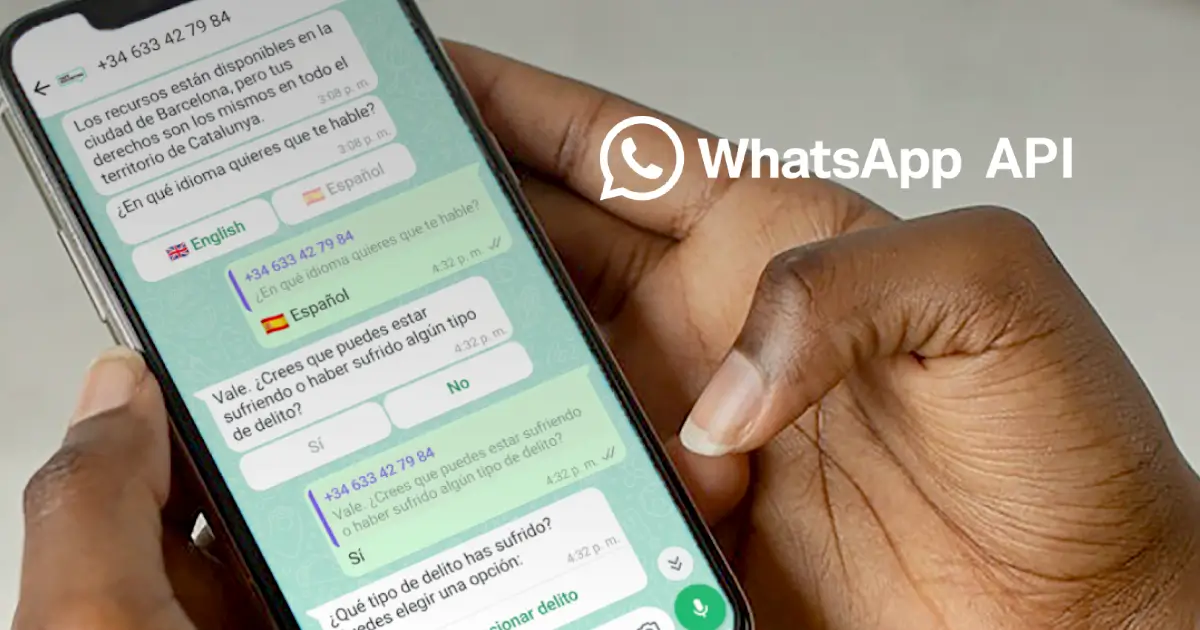
Cover photo: Cristina Pérez Ruiz.