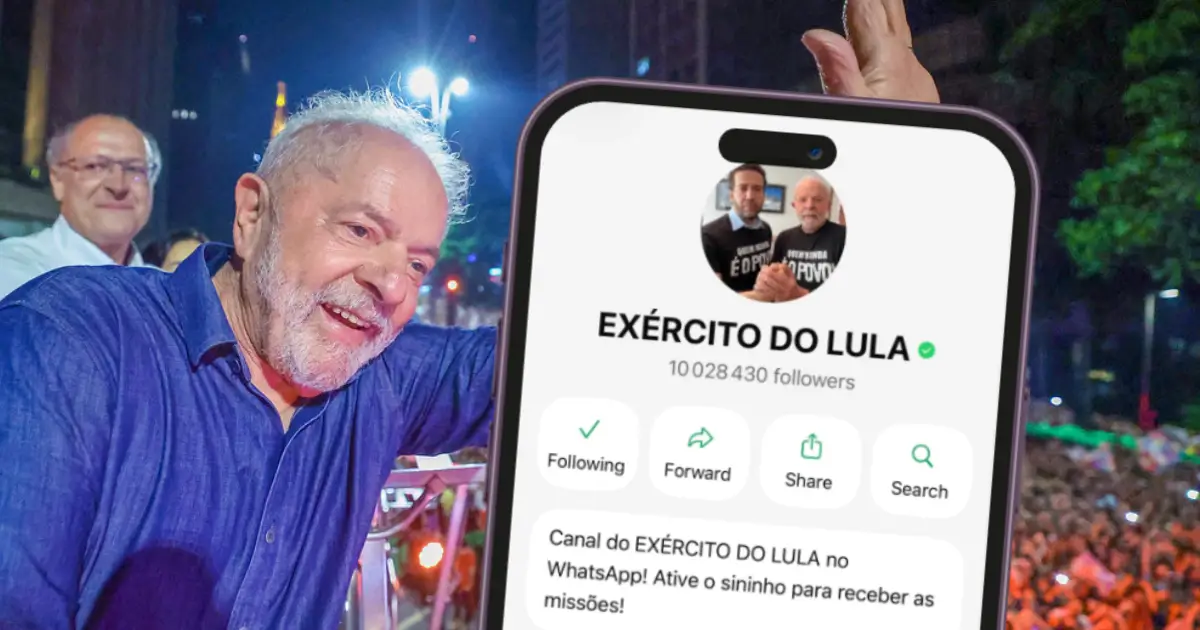
Three days ago we wrote about how Exército do Lula, a WhatsApp channel with no party logo and one person out front, went from 55,000 to 10 million followers in the three weeks before Brazil's runoff. Lula won and mentioned the channel in his speech that same night.
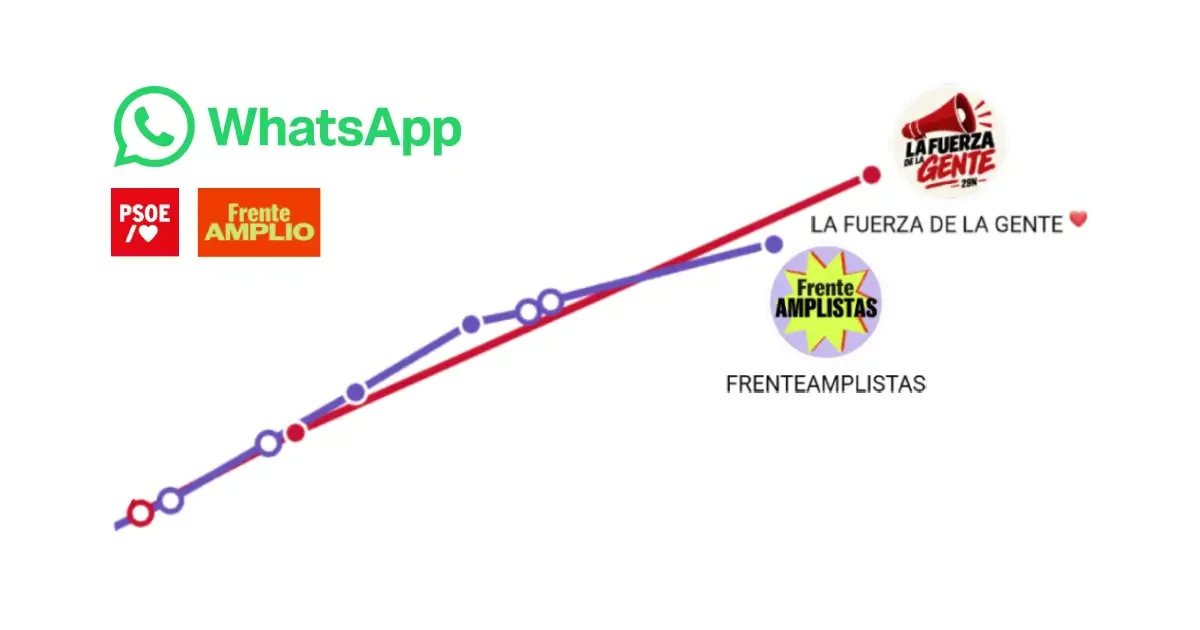
Spain votes in a general election on 29 November, thirty days from now, and two left-wing campaigns seem to have been paying attention. La Fuerza de la Gente ("The Strength of the People"), a channel run by PSOE supporters that uses the party's campaign slogan, and FRENTEAMPLISTAS, which was Frente Amplio's official channel until 27 October, are right now the two fastest-growing political channels of all the ones we track in Spain. We went through their 139 posts one by one in PSOE vs Frente Amplio: the WhatsApp battle, in data. This piece covers the context, what they took from Lula, and what PP is doing in the meantime.
The numbers
We read the public follower counts of Spanish parties' channels every day. This morning's (29 October, 9:39 UTC) look like this:
| Channel | Early October | 26 Oct | 29 Oct |
|---|---|---|---|
| La Fuerza de la Gente | 1,300 (11 Oct) | no reading | 40,827 |
| FRENTEAMPLISTAS (formerly "Frente Amplio 29N") | 927 (16 Oct) | 3,204 | 35,463 |
| PP | 6,752 (11 Oct) | 7,053 | 7,097 |
| PSOE, official channel | 5,185 (10 Oct) | 5,377 | 5,567 |
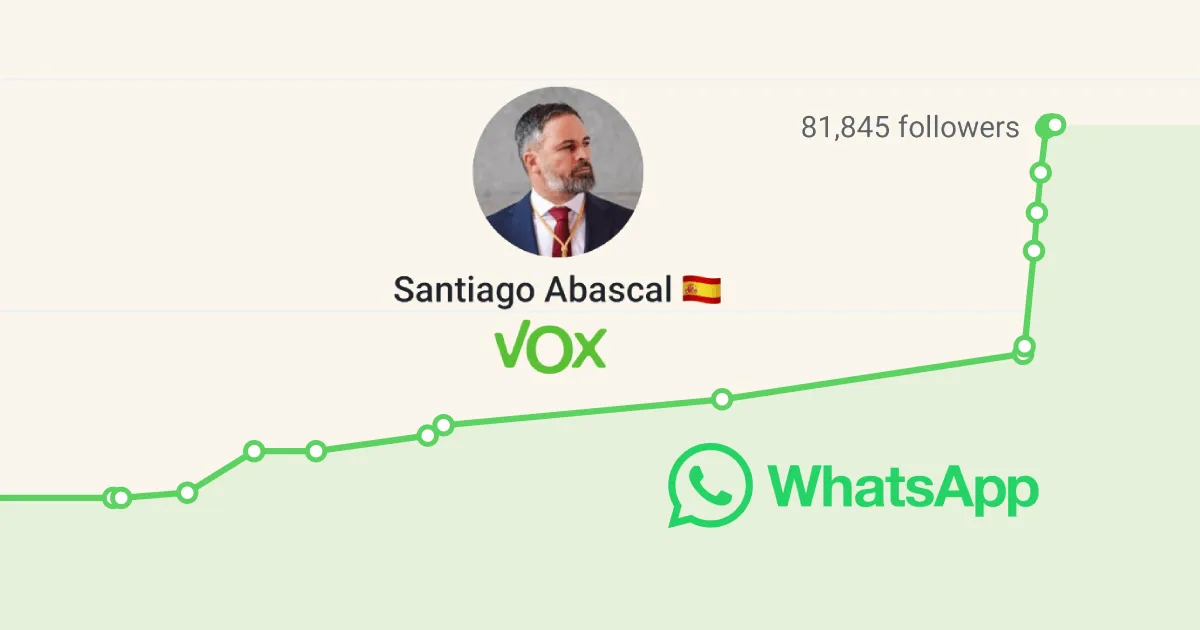
| VOX (Santiago Abascal) | 84,713 (11 Oct) | 88,242 | 89,484 |
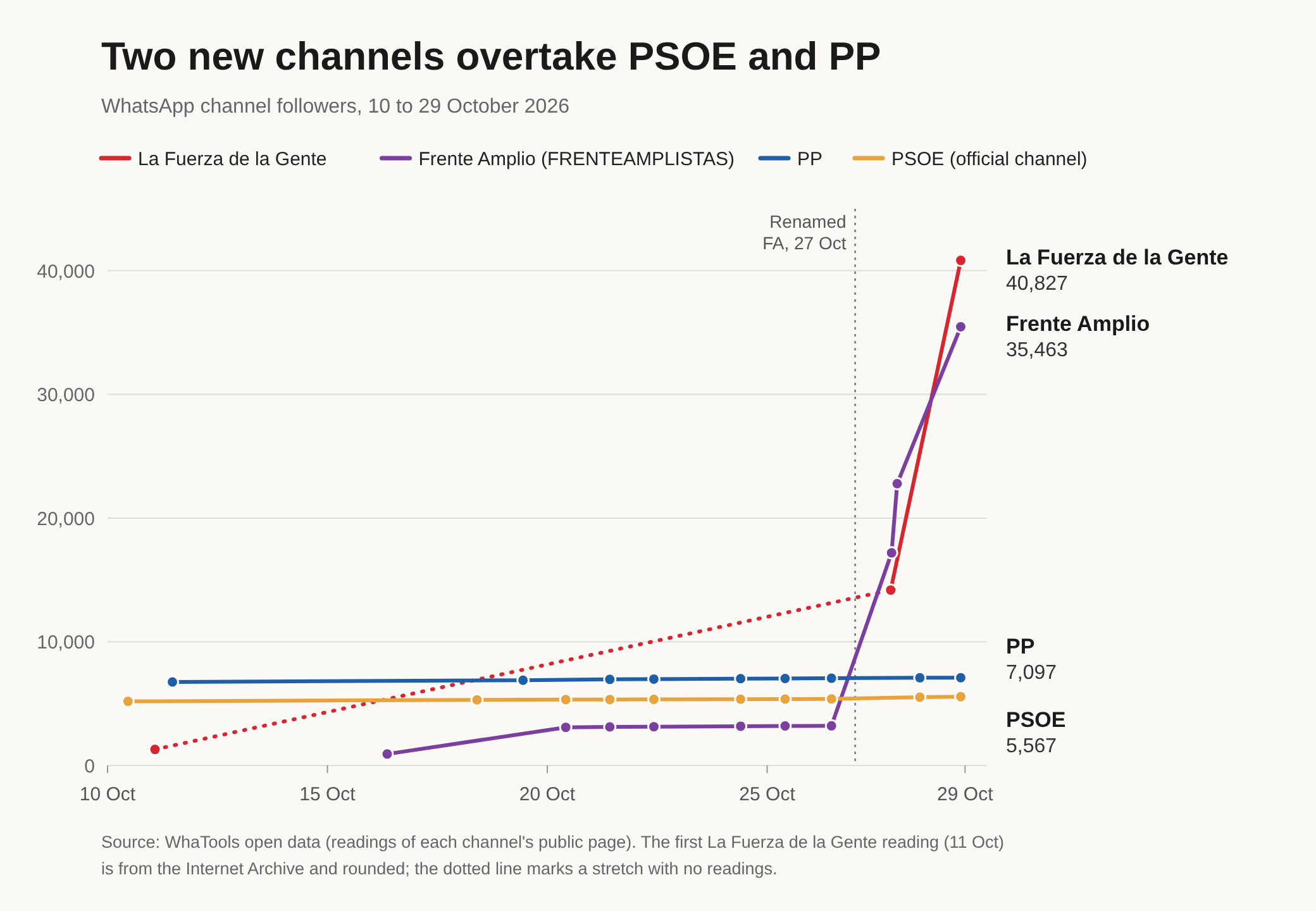
La Fuerza de la Gente now has 31 times the followers it had on 11 October, and seven times as many as PSOE's official channel. FRENTEAMPLISTAS has grown 38-fold in thirteen days. Both took off on the same day, 27 October, two days after Lula won, and both have overtaken PP and PSOE. Of the Spanish parties we track, only VOX has more followers.
A note on La Fuerza de la Gente's first figure: it comes from an Internet Archive copy of 11 October, where WhatsApp showed it rounded. We started reading the channel ourselves on the 27th, so we have no data between those two dates.
This time it doesn't look like bought followers
In September we wrote that VOX had doubled its followers in twelve days along a curve that was too straight, stopped dead, and came with reactions per post that didn't keep up. A fake follower adds to the counter but never reacts or forwards anything.
The pattern here is different. Behind each jump there is a specific post asking people to forward the channel, and it was forwarded thousands of times, as we show below. The growth is driven by the followers themselves, in the month before an election.
That doesn't mean the newcomers behave like the people who were there before. On FRENTEAMPLISTAS, interaction per follower fell from 6.4% before the sprint to 1.9% on 28 and 29 October. Part of that is the subject matter: on the 28th the channel paused campaigning to cover the Urda train crash, with practical messages that aren't after reactions. But it also shows that the 30,000 who arrived in two days don't yet take part the way the first 3,000 did. That's normal after a wave of forwards, and it looks nothing like VOX's straight ramp.
If anything looks odd, it's VOX. After that jump, its channel has barely moved in the middle of the pre-campaign: from 20 to 29 October it gained 1,746 followers, 2%. An audience that really shares things usually shows up when the campaign starts.
Two ways to copy Lula
The Brazilian model had two parts. The channel didn't belong to the Workers' Party but to André Janones, a congressman who spoke in the first person. And it didn't just inform: every morning it sent its followers "missions" (push a hashtag, forward a video, wear green and yellow).
Javier Toret and Rocío Guerrero, who analysed the case in El Salto, sum it up by saying the channel "organised virality" instead of waiting for something to go viral: strategy came from the centre, and each follower carried it out from their own accounts. One of the lessons they draw is to set concrete, observable, short-term goals. They also warn that experiences like this can't be transplanted mechanically to another country.
Frente Amplio and PSOE have copied the second part in a similar way and the first in different ones.
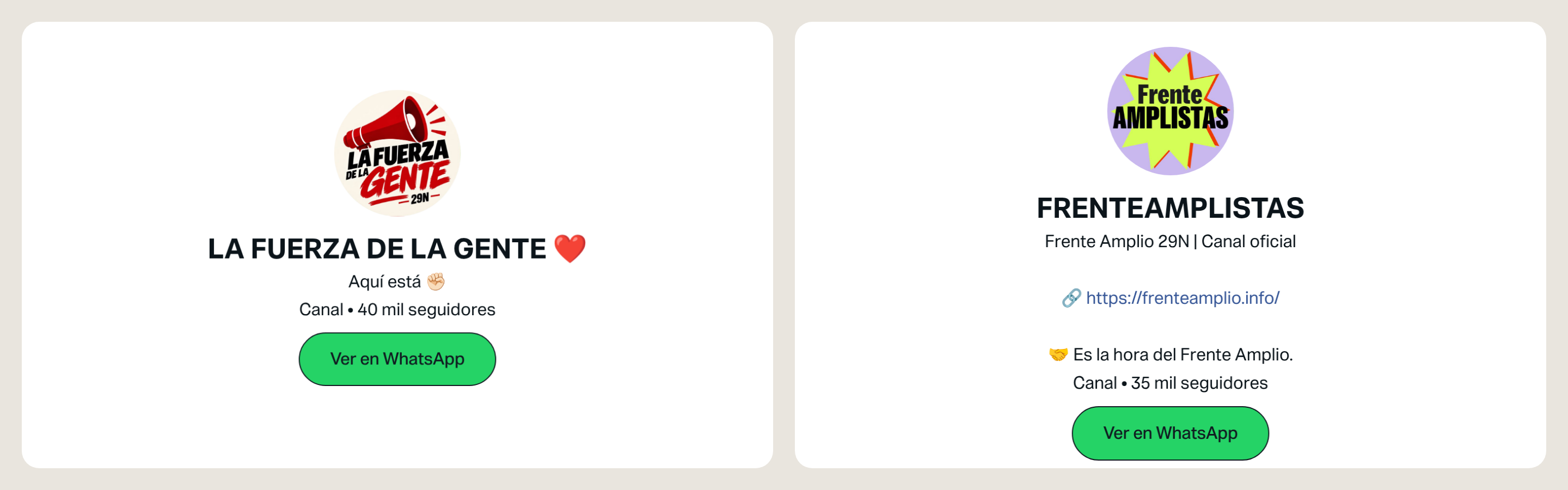
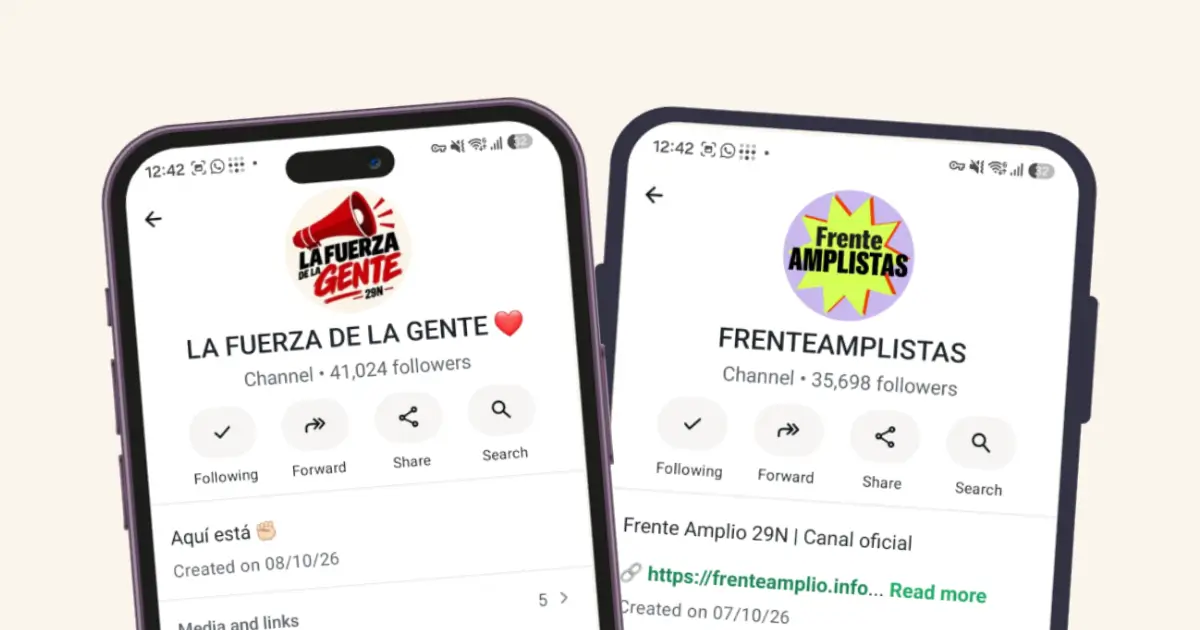
Frente Amplio has turned its official channel into an activists' one. It created it on 7 October as "Frente Amplio 29N", and on the 27th it became "FRENTEAMPLISTAS" (roughly "Broad Fronters"), with a new avatar of a yellow star on a lilac background. Since that day it has talked like a supporters' channel, with missions and follower targets, and the party no longer has an official WhatsApp channel, although the description still says "Frente Amplio 29N | Canal oficial" and links to its website. The change and the jump came together. On the 26th it had 3,204 followers; on the evening of the 27th, 17,190. Three hours later it had 22,779.
PSOE, by contrast, keeps its official channel and has a supporters' channel alongside it. The official one, "PSOE 🌹", is still there with its 5,567 followers, and since 8 October there has been "La Fuerza de la Gente", with a megaphone, the election date in its logo and a two-word description: "Aquí está ✊🏻" (here it is). The channel's page doesn't say it belongs to the party, but its name is the slogan Pedro Sánchez wears on his T-shirt in one of its stickers, and what it posts is video from his rallies.
Having both makes sense, and it has a cost. In its favour: some people would never follow a channel called "PSOE" but will follow one that sounds like a movement, and the channel can take a tone the party wouldn't sign. Against it: it splits the audience in two, and the official channel gets nothing from the growth. Someone following La Fuerza de la Gente also can't check who's behind it, and anyone could open a channel with a similar name tomorrow. And it's not clear what happens to those 40,000 followers after the 29th.
Frente Amplio solved the same problem another way. Instead of starting a channel from scratch, it kept the official channel's followers and changed its name and tone, so it didn't split its audience. The price is that the party no longer has a channel of its own, and anyone who joined looking for the official one is now in an activists' channel.
Orders, content and tone
Both follow Janones's recipe: give concrete instructions and hand out content ready to forward. What changes is the voice, and in our post-by-post analysis the result is clear: La Fuerza de la Gente is bigger and FRENTEAMPLISTAS is more effective. Frente Amplio's channel posts half as much (45 posts against 94), and its typical post gets reactions and forwards equal to 4.9% of its followers, against 3.7% for La Fuerza de la Gente. In forwards, which is what grows a channel, the gap is wider: 1.5% against 1.0%.
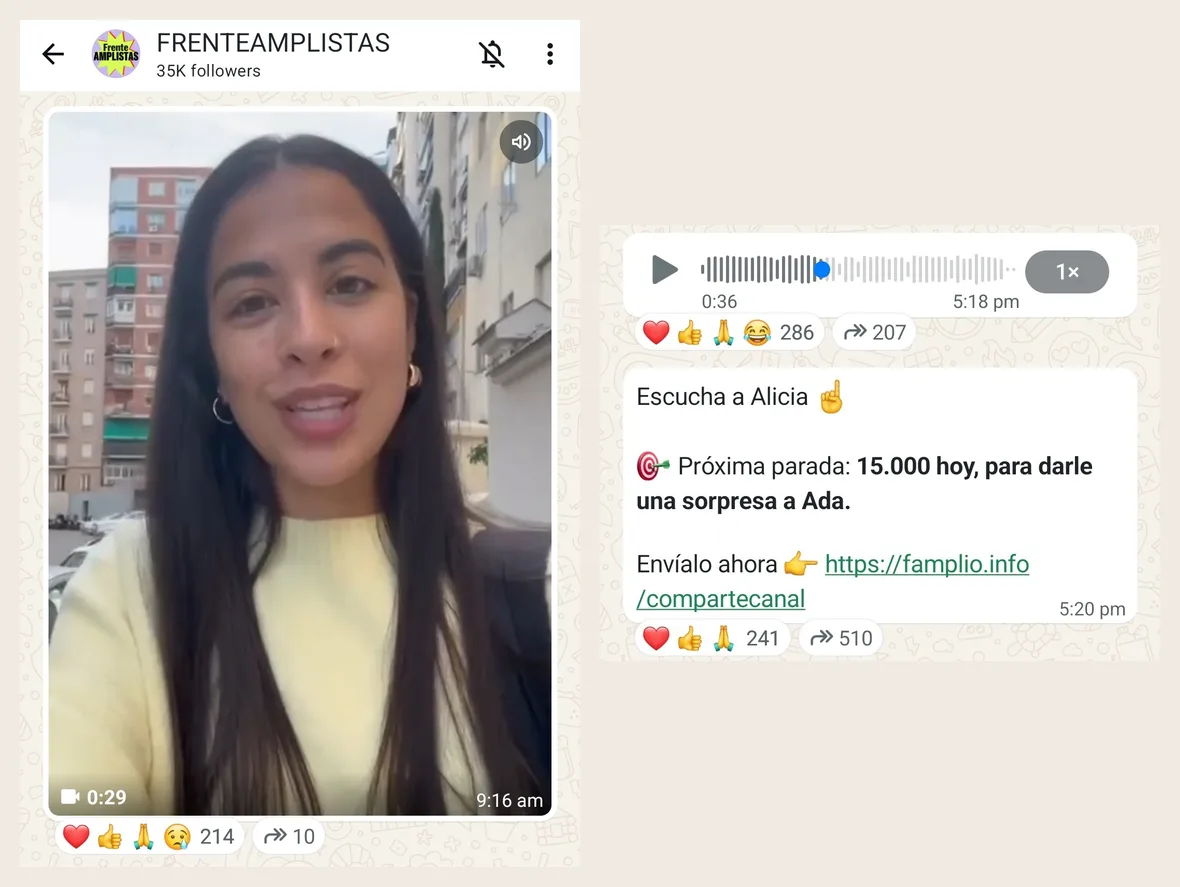
FRENTEAMPLISTAS follows Janones's script more closely. At midday on 27 October it posted "Objetivo 10.000" (target 10,000): a goal, a task (forward the channel to four friends) and a short link. It was forwarded 2,000 times, 40% of its followers at the time. It then ran a countdown ("1,700 to go to 10,000") and raised the bar: after a voice note from Alicia, a volunteer, came "Next stop: 15,000 today, to surprise Ada". The surprise was a voice message from Ada Colau, its candidate, posted that night once the channel reached 15,000, which got more than 1,000 reactions and more than 1,000 forwards. Voice notes are its best format: it has posted four, and their median (9.0% of followers) is nearly double any other format's. A numbered target that everyone can watch being met is exactly the kind of goal Toret and Guerrero describe.
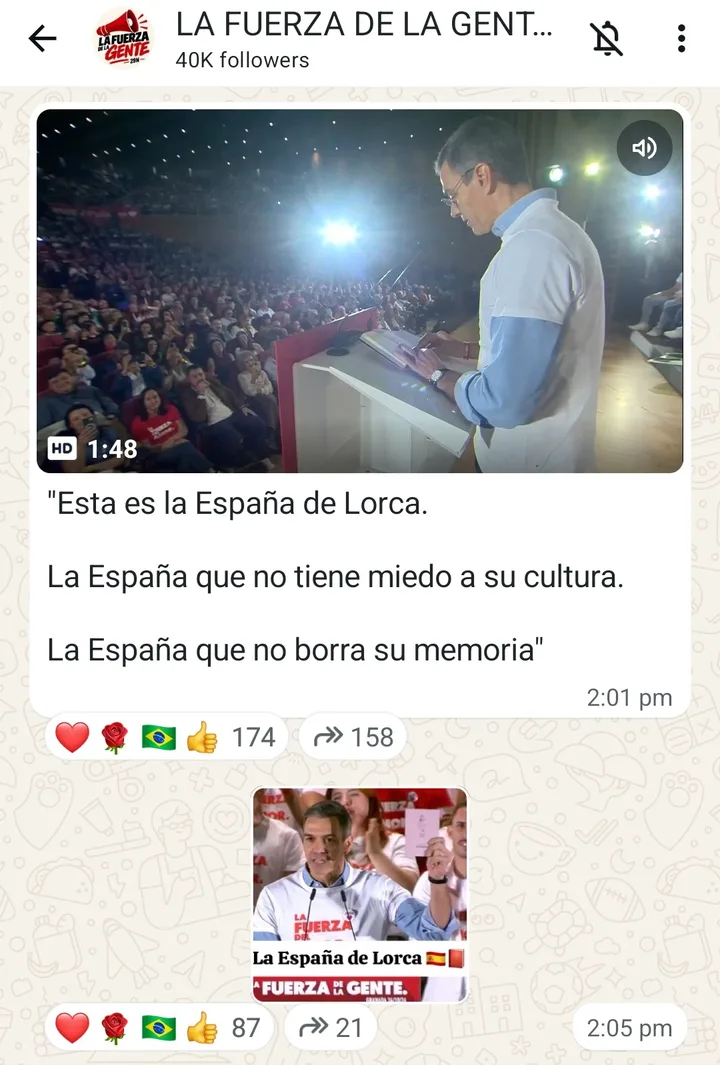
La Fuerza de la Gente works more like a content agency. It posts nearly five times a day, mostly clips from Sánchez's rallies, such as a 1:48 one with the line "This is Lorca's Spain. The Spain that isn't afraid of its culture. The Spain that doesn't erase its memory" (174 reactions, 158 forwards), and sometimes the same message as a sticker (87 reactions, 21 forwards). Stickers are the channel's own idea, but they perform at less than half the level of an image: 1.8% of followers against 4.7%. Its most viral post does follow the Brazilian script. "SOMOS YA 7.000" (we're 7,000 now), on 27 October, asked people to forward the channel "to 3 friends or 4 years of PP government" and was forwarded 10,000 times, more than the channel had followers. But it was a one-off, and the rest of what it posts does less.
Camila Modanez puts it well in Página/12 when writing about Janones: his achievement wasn't gathering followers but creating "a dynamic of participation", because "organised people have a much greater capacity for action than individuals who simply consume content". That's the difference between the two channels. FRENTEAMPLISTAS asks its followers to do something and shows them the result. La Fuerza de la Gente mostly gives them something to watch.
Why WhatsApp
IAB Spain's 2026 Annual Social Media Study gives the reasons. 94% of social media users in Spain used WhatsApp in the last month, three points more than the year before, and 97% of them open it every day. 99% know it. It's the favourite network of one user in three (33%, though that's down four points while Instagram is up five). And people spend an average of 1 h 29 min a day on it (men) and 1 h 39 min (women), when the average time on social networks is around 50 minutes.
A channel also costs nothing. No algorithm decides who sees each post, and what gets posted leaves the channel as forwards into private chats and groups, where it arrives with the trust of whoever sent it. That's what made Exército do Lula work. The weak spot is that WhatsApp mutes channels by default, which is why Janones asked everyone to turn on the bell.
PP has picked the expensive route
PP has gone another way. It has launched intereses.pp.es, under the slogan "Lo que te importa, en tu WhatsApp" (what matters to you, on your WhatsApp). According to Demócrata, the site offers nine topics (from "Summary of the day" to "Housing and land", "Immigration, borders and security" or "Electoral process and guarantees"). You pick the ones you care about, give your number and authorise the party to use it to message you on WhatsApp. The messages arrive through the official WhatsApp Business API.
We checked by signing up. The first message comes from a business account called "Partido Popular", with a Spanish number that WhatsApp flags as joined in the last month. It thanks you "for joining the Partido Popular's WhatsApp channel", although it isn't a channel but a private chat, and it has two buttons underneath: "Darme de baja" (unsubscribe) and "Cambiar mis intereses" (change my interests). The WhatsApp Business app can't send buttons like that; you need the API.
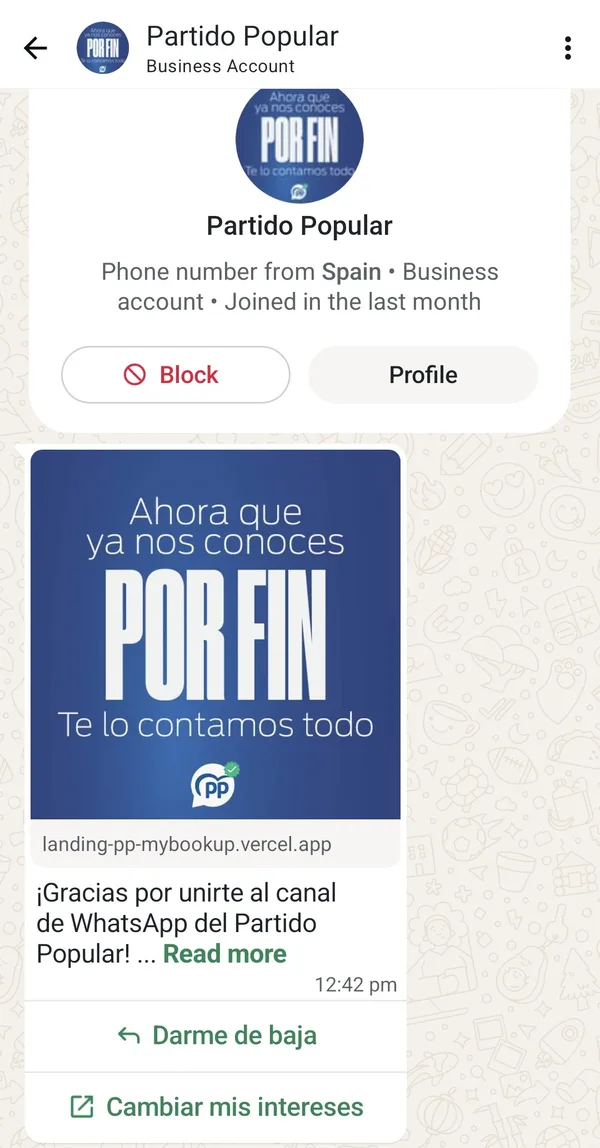
That clashes with Meta's rules, which close WhatsApp's business platform to parties and campaigns. We're surprised a major party uses it in the middle of a campaign, because it risks Meta blocking the number halfway through.
It's also expensive. At Meta's current rates, each marketing message to a Spanish number costs about €0.0585, as you can check in our API pricing calculator. One message a day to 20,000 people for a month is 600,000 messages and about €35,000. And it only reaches people who signed up on PP's website first, who are hardly undecided voters. Its channel, which costs nothing per message, has 7,097 followers.
A channel doesn't win elections
It's worth not overstating what a channel can do. Modanez points out that Lula didn't win thanks to Exército do Lula alone: his government's record mattered too, as did the end of the six-day working week, students on the streets, fan communities, and Geração Lula, which mobilised voters over 70. A WhatsApp channel organises people who already want to act, but it doesn't win an election on its own.
You can follow all these channels day by day in the ranking of Spanish parties on WhatsApp.